You book a White Desert safari in Egypt, open the itinerary and suddenly discover two places:
Old White Desert
and
New White Desert.
Naturally, the questions start.
Are they two different deserts?
Is one actually older than the other?
Which one has the famous mushroom-shaped rocks?
Which is better for camping?
Can you visit both in one trip?
And if you’re traveling all the way from Cairo, which one should you prioritize?
The short answer is simple:
The Old White Desert and New White Desert are not two separate national parks. They are commonly used local and tourism labels for different sections of Egypt’s wider White Desert landscape.
Egyptian government sources describe the White Desert Protected Area as one continuous protected landscape north of Farafra Oasis, famous for its chalk and limestone formations, dunes, cliffs, fossils and desert ecosystems. They do not formally divide the protected area into two separate parks called “Old White Desert National Park” and “New White Desert National Park.”
The Old/New distinction is nevertheless useful for travelers because the sections can feel different.
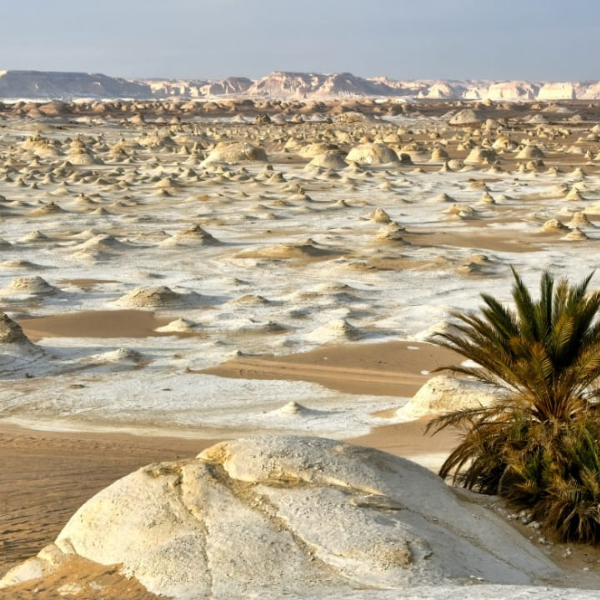
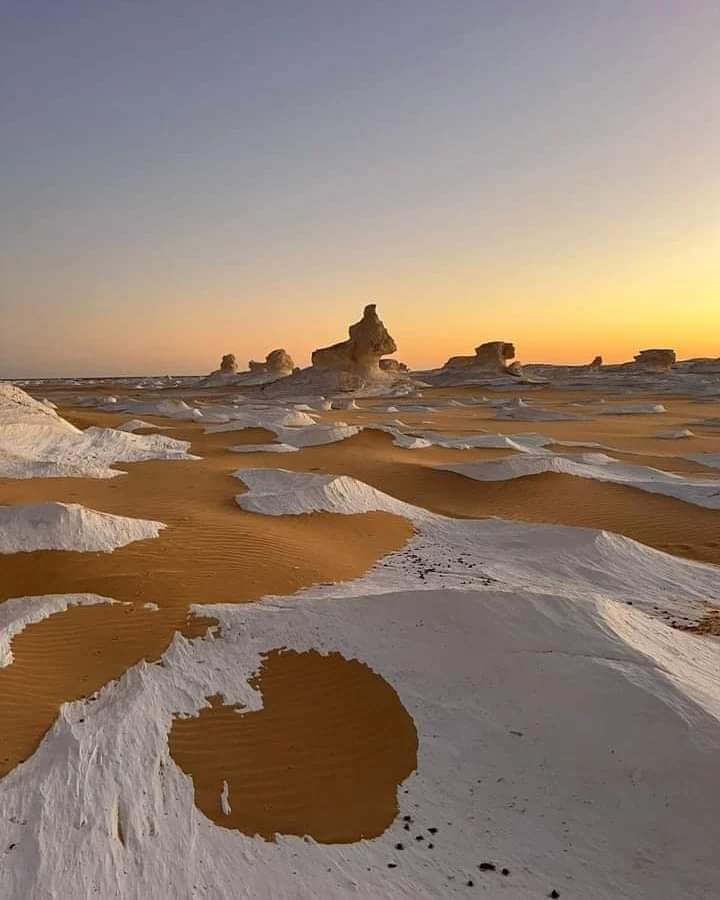
One may offer dense clusters of familiar wind-carved shapes.
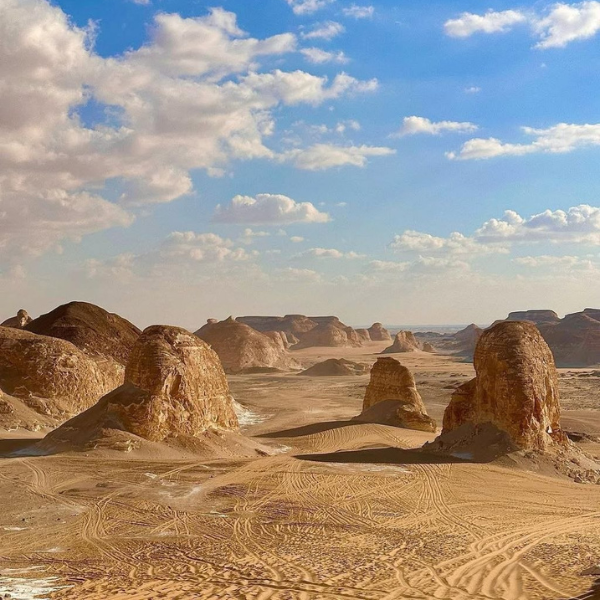
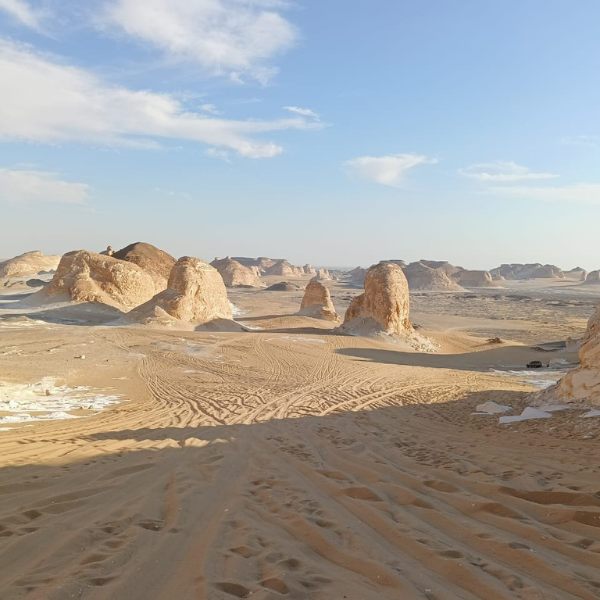
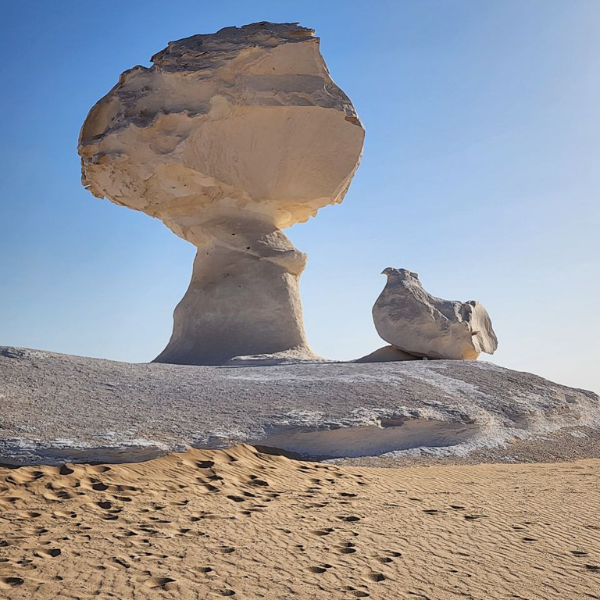
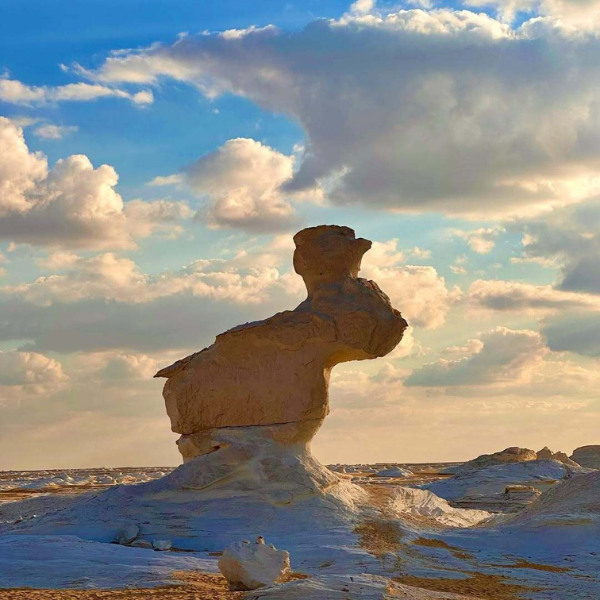
Another can feel more spacious and isolated, with individual formations standing across broad pale desert plains.
And on a good overnight safari, you normally don’t need to choose between them.
You experience both.
For an overview of the whole destination first, read our White Desert Egypt Complete Guide.
If you’re already planning the journey from Cairo, explore the White Desert Safari from Cairo.
White Desert Safari: Cairo, Bahariya Oasis & Camping Adventure
Egypt Desert Dunes Explore the Journey Stop 01 White Desert Swipe photos ‹ › White Desert White Desert White Desert White Desert White Desert…
White Desert Overnight Tour from Cairo
Egypt Desert Dunes Explore the Journey Stop 01 White Desert Swipe photos ‹ › White Desert White Desert White Desert White Desert White Desert…
White Desert 3 Days Tour from Cairo
Egypt Desert Dunes Explore the Journey Stop 01 White Desert Swipe photos ‹ › White Desert White Desert White Desert White Desert White Desert…
Djara Cave and White Desert Safari
Egypt Desert Dunes Explore the Journey Stop 01 White Desert Swipe photos ‹ › White Desert White Desert White Desert White Desert White Desert…
White Desert Camel Safari
Egypt Desert Dunes Explore the Journey Stop 01 White Desert Swipe photos ‹ › White Desert White Desert White Desert White Desert White Desert…
Western Desert Tour from Cairo
Egypt Desert Dunes Explore the Journey Stop 01 White Desert Swipe photos ‹ › White Desert White Desert White Desert White Desert White Desert…
Old vs New White Desert at a Glance
Feature | Old White Desert | New White Desert |
What is it? | Informal name for one section of the White Desert | Informal name for another section |
Separate national park? | No | No |
Landscape style | Often described as denser clusters of chalk formations | Often described as broader, more open landscapes with isolated formations |
Typical formations | Mushroom- and tent-like forms are commonly associated with itineraries here | Camel, Sphinx, Chicken/Mushroom and other named formations appear in many itineraries |
Photography | Excellent for close formations and shapes | Excellent for panoramas, sunset and isolated silhouettes |
Camping | Possible depending on approved itinerary | Commonly included in safari itineraries |
Access | Usually by organized desert safari | Usually by organized desert safari |
Can you visit both? | Yes | Yes |
Best trip format | Overnight or multi-day White Desert safari | Overnight or multi-day White Desert safari |
One warning before we go deeper:
The names and exact boundaries are not used consistently by every local guide or tour operator.
One itinerary may assign a particular formation to the Old White Desert while another guide describes the same wider zone differently.
So treat Old and New White Desert as useful safari terminology — not as precise administrative boundaries on the level of two separate protected areas.
What Is the White Desert Egypt?
Before comparing Old and New White Desert, it helps to understand the landscape they belong to.
Egypt’s White Desert lies in the Western Desert, north of Farafra Oasis.
The official Egyptian tourism portal says the White Desert is approximately 40 km from Farafra and highlights its famous mushroom-shaped white rocks, desert excursions, camping and 4×4 travel.
The protected landscape is extraordinary because much of it is formed from pale chalk and limestone.
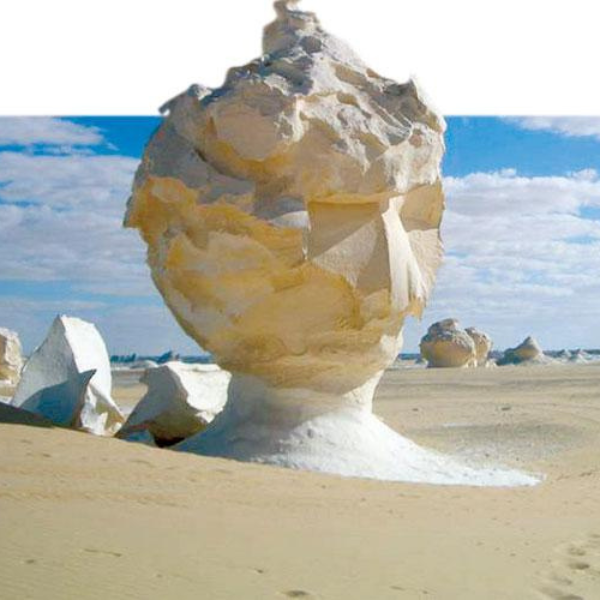
Wind, sand and long-term erosion have sculpted this relatively soft material into shapes that can resemble:
mushrooms,
towers,
animals,
cones,
columns,
faces,
and abstract sculptures.
Egypt’s Environmental Affairs Agency describes the White Desert Protected Area as containing a remarkable range of landscapes, including the cliffs along the northern edge of the Farafra Depression, dunes connected with the Great Sand Sea, wadis and small oasis habitats.
The official Experience Egypt portal goes further back, describing the landscape as originating from an ancient seabed and noting that marine fossils can still be found within limestone layers.
In other words:
The White Desert isn’t simply “white sand.”
It is a geological landscape created over millions of years.
Is the Old White Desert Actually Older?
This is probably the most misleading part of the name.
Do not interpret “Old White Desert” as meaning geologists have officially classified it as an older desert than the New White Desert.
Both landscapes are products of ancient geological processes.
The terms are primarily useful route names.
There is no official Egyptian government classification saying:
Old White Desert = geological period A
and
New White Desert = geological period B.
The entire protected region contains very old sedimentary rocks and erosion features.
So when a guide says:
“Now we are entering the New White Desert.”
think:
“We’re moving into another commonly named section of the safari landscape.”
Not:
“We have crossed into a geologically young desert.”
That little distinction makes the whole itinerary much easier to understand.
What Is the Old White Desert?
The Old White Desert is commonly used in safari itineraries for areas with dense groups of pale chalk formations.
Travel operators frequently describe this section using landmarks or formation areas such as:
mushroom shapes,
tent-like rocks,
panoramic White Desert viewpoints,
and flower-stone areas.
Current tour descriptions consistently associate Old White Desert sections with clusters of formations resembling mushrooms and tents.
But the most important feature isn’t the nickname of one rock.
It’s density.
In some Old White Desert areas, several formations appear relatively close together.
That creates a very interactive experience.
You get out of the vehicle.
Walk between formations.
Move around a rock.
And suddenly a shape that looked like a mushroom from one side becomes completely different from another.
This makes the Old White Desert particularly enjoyable for travelers who like exploring at walking speed rather than seeing everything through the window of a 4×4.
What Does the Old White Desert Look Like?
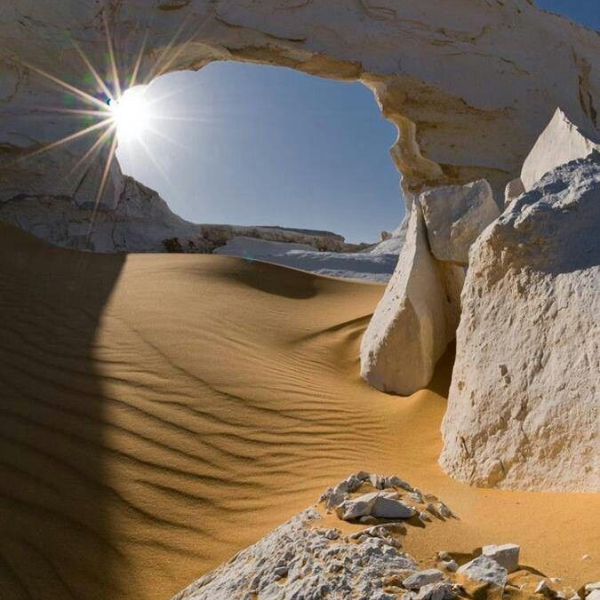
Imagine pale ground covered by sculpted chalk forms.
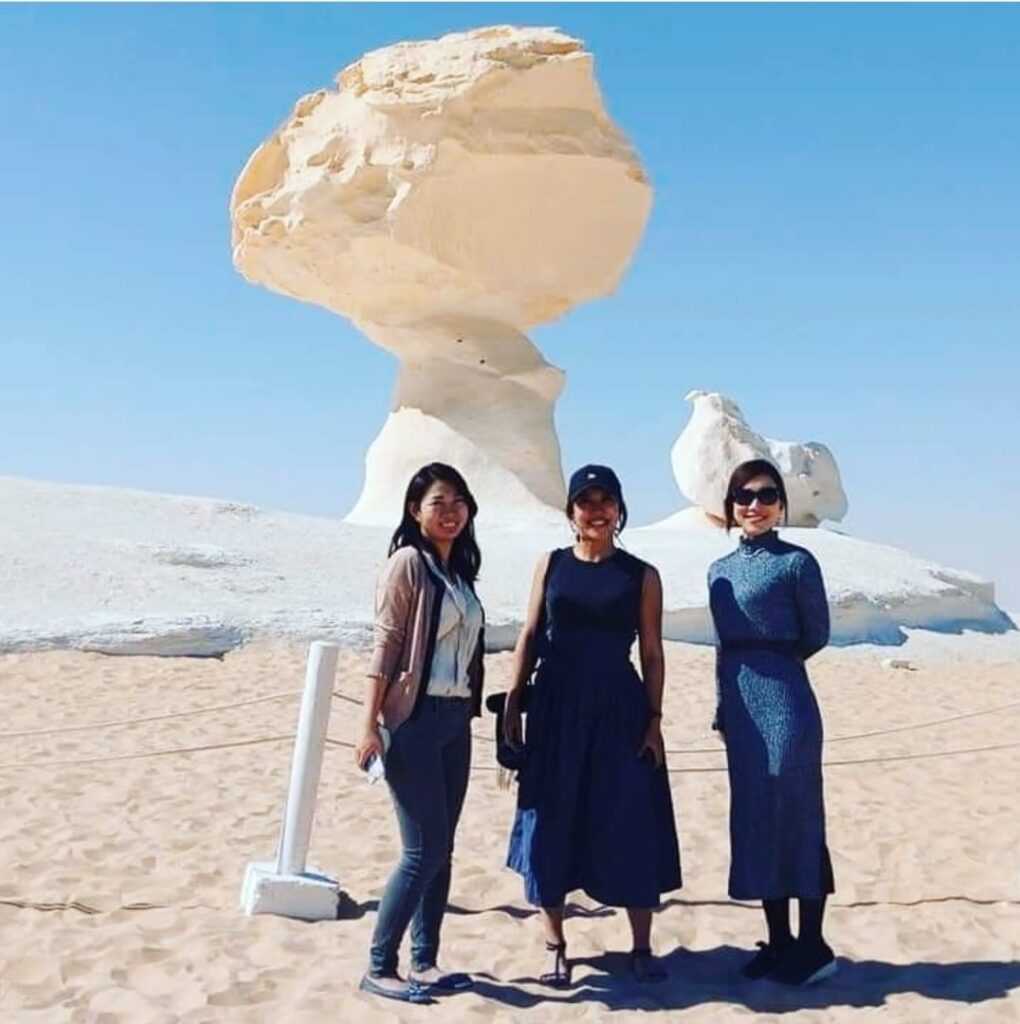
Some formations have narrow bases supporting larger upper sections.
Others have curved roofs.
Some look almost like tents.
Some have no obvious comparison at all.
Bright midday sun makes the landscape extremely white.
Later sunlight changes it.
The formations gradually become:
cream,
warm beige,
gold,
and finally darker silhouettes.
That changing light is one reason an overnight safari offers much more than a rushed stop.
The White Desert you see at 2 PM does not feel like the same place at sunset.
What Is the New White Desert?
The New White Desert is another informal safari label used for sections of the wider protected landscape.
Current tour descriptions commonly portray the New White Desert as a more open or surreal section containing impressive isolated limestone or chalk formations and panoramic views.
Named shapes frequently associated with New White Desert itineraries include:
Camel,
Sphinx,
Chicken,
Mushroom,
and other imaginative forms.
Again, don’t become too obsessed with whether every guide places every named rock in exactly the same category.
There is some variation in terminology.
What matters for the traveler is that the scenery evolves.
You may move away from denser formations and enter larger open plains where isolated chalk sculptures become visible from farther away.
That sense of space changes the experience completely.
Old White Desert vs New White Desert: The Main Difference
If we simplify the experience without pretending there are rigid official borders:
Old White Desert
Often feels more concentrated.
You notice multiple formations fairly close together.
Walking and examining shapes becomes part of the experience.
New White Desert
Often feels more open and panoramic.
Individual formations can stand against broad desert horizons.
The landscape can feel more isolated and cinematic.
That’s why some photographers may prefer one for close compositions and another for panoramic frames.
But this isn’t a rule written into Egyptian protected-area law.
It’s a practical travel distinction based on how many current safari itineraries describe the landscape.
Are the Old and New White Desert Separate National Parks?
No.
Egypt formally declared the White Desert Protected Area in 2002.
Egypt’s Environmental Affairs Agency describes the park as one protected landscape with multiple geological and ecological zones.
Likewise, Egypt’s official tourism portal talks about:
The White Desert
rather than separate official parks called:
Old White Desert National Park
and
New White Desert National Park.
So if you’re creating your itinerary, don’t search for two separate park entrances.
Think of them as sections experienced within the wider White Desert safari.
Which White Desert Has the Famous Mushroom Rock?
Here’s where things get amusing.
Ask five websites and you may get more than one answer.
Some tour itineraries associate classic mushroom and tent shapes strongly with the Old White Desert.
Others place famous Chicken and Mushroom Rock among their New White Desert highlights.
This inconsistency isn’t necessarily because somebody is lying.
It’s because:
- the labels are informal;
- the landscape covers a wide area;
- formations have local nicknames;
- transliterations vary;
- and different guides organize the route differently.
The safe and useful answer is:
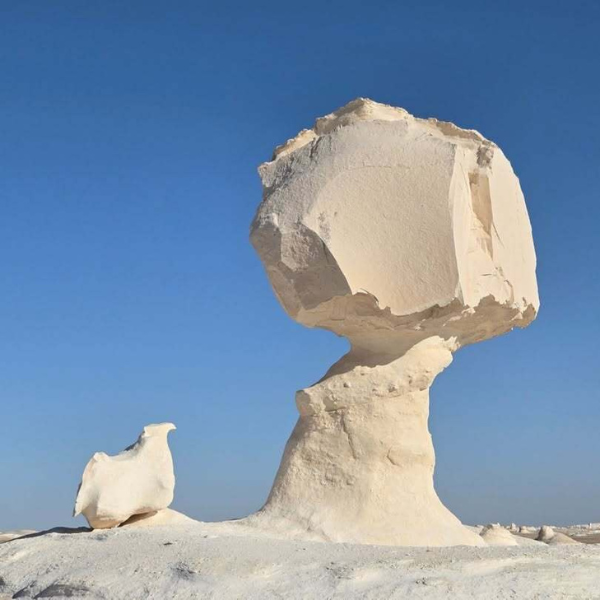
Mushroom-shaped formations occur throughout the wider White Desert landscape, while specific named formations may be assigned to Old or New White Desert differently depending on the itinerary.
For a broader guide to these natural sculptures, read our White Desert Rock Formations Guide.
Why Are the Rocks Shaped Like Mushrooms?
Wind is a major sculptor of the White Desert.
Windblown sand repeatedly abrades exposed chalk and limestone.
Near ground level, moving sand can erode portions of a formation faster than higher sections.
Over enormous periods of time, that process can leave:
narrower bases
supporting
wider upper sections.
The result resembles a mushroom.
But not every White Desert sculpture forms identically.
Differences in rock hardness, fractures, layering and exposure all affect the final shape.
The important thing to remember is that you’re looking at a landscape still changing today.
The formations aren’t finished artworks.
Erosion continues.
Why Is the White Desert White?
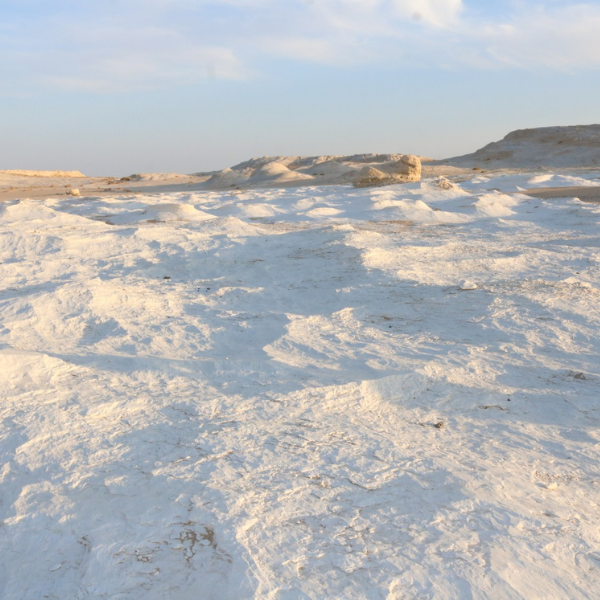
The striking color comes largely from pale chalk and limestone deposits.
Egypt’s tourism authority describes the White Desert as a landscape shaped from chalk-white limestone, while its natural-protectorate material notes the area’s ancient marine origins and visible marine fossils.
That explains why the landscape can sometimes feel more like:
snow,
ice,
or another planet
than the Sahara most people imagine.
The nearby Black Desert makes the contrast even stronger.
Within one safari, travelers can go from:
dark hills,
to golden sand,
to crystalline geological features,
to enormous cream-colored valleys,
and finally to brilliant white chalk.
That’s one reason the classic Western Desert route is so visually satisfying.
Old White Desert vs New White Desert for Photography
Both are excellent.
But you can approach them differently.
Photographing the Old White Desert
Look for:
close formations,
repeated shapes,
curved rock surfaces,
people for scale,
textures,
and compositions using multiple rocks.
You can move around an individual formation and discover completely different photographs from different angles.
Best style:
Medium-wide and close landscape work.
Photographing the New White Desert
Look for:
isolated silhouettes,
large sky,
negative space,
sunset,
formation-and-horizon compositions,
and broader panoramas.
An individual white rock surrounded by empty desert can sometimes produce a stronger image than a frame crowded with dozens of formations.
Best style:
Wide landscapes and minimalist desert photography.
Which Is Better at Sunset?
There isn’t one permanent answer because route timing, cloud, season and exact location matter.
But open White Desert areas are spectacular when the sun gets lower.
Why?
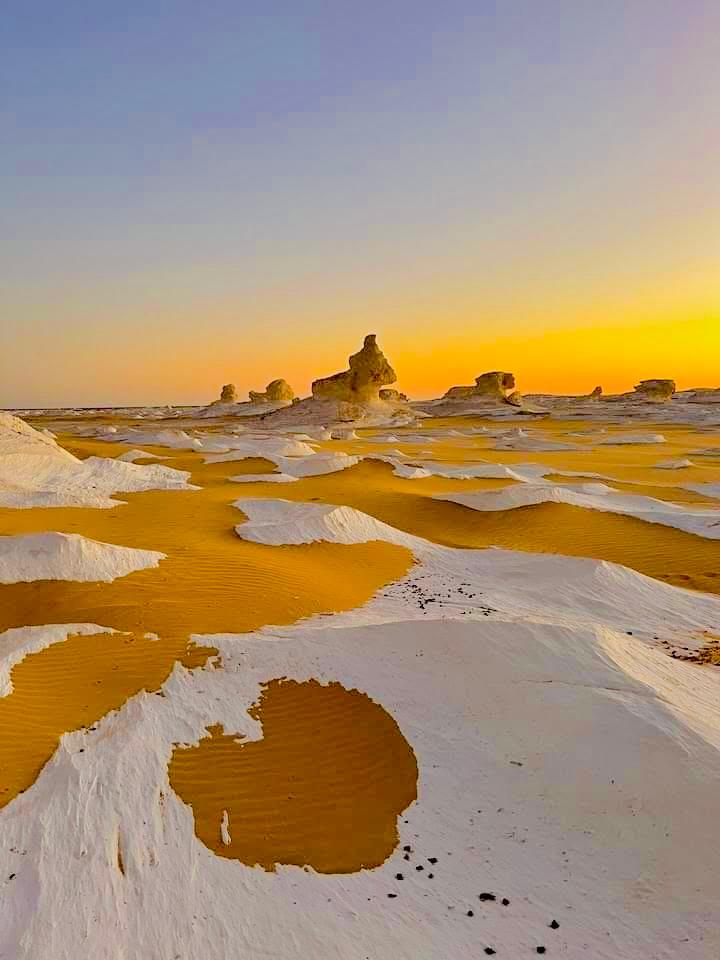
The white chalk stops looking pure white.
It begins to catch warm light.
The shadows stretch across the ground.
Texture becomes much more visible.
And rock silhouettes become easier to separate from the background.
Many safari itineraries deliberately organize the final section of the day around sunset and camping within the wider New White Desert landscape.
For serious photography planning, use our White Desert Photography Tips.
Which Is Better for Sunrise?
Whichever one you wake up in.
That sounds like a joke, but it’s genuinely the useful answer.
A good camp location can provide spectacular early light in either part of the White Desert.
Sunrise works differently from sunset.
Before the Sun appears, the rocks can look:
grey,
blue,
or almost silver.
Then the first warm light hits their upper surfaces.
The contrast increases quickly.
Within minutes, the desert becomes bright again.
If sunrise photography matters to you, the quality of your camp location and itinerary timing matters more than chasing the label “Old” or “New.”
Old White Desert vs New White Desert for Camping
Camping is one of the main reasons travelers choose an overnight White Desert safari.
Current itineraries often place camps in or near the wider New White Desert section because open landscapes provide spectacular sunset, night-sky and sunrise conditions.
But this does not mean travelers can simply choose any attractive location and pitch a tent.
The White Desert is protected.
Camping locations and vehicle access should follow current rules, permits and guidance from authorized operators.
Egypt’s official tourism portal specifically tells travelers to check permits and current regulations before heading into the desert.
For the actual overnight experience, read our White Desert Camping Guide.
What Is Camping in the White Desert Like?
Forget resort camping.
A classic desert camp is about simplicity.
Depending on the operator and package, you may have:
tents,
mattresses,
sleeping bags,
blankets,
low seating,
dinner,
Bedouin-style tea,
and breakfast.
The real luxury is the location.
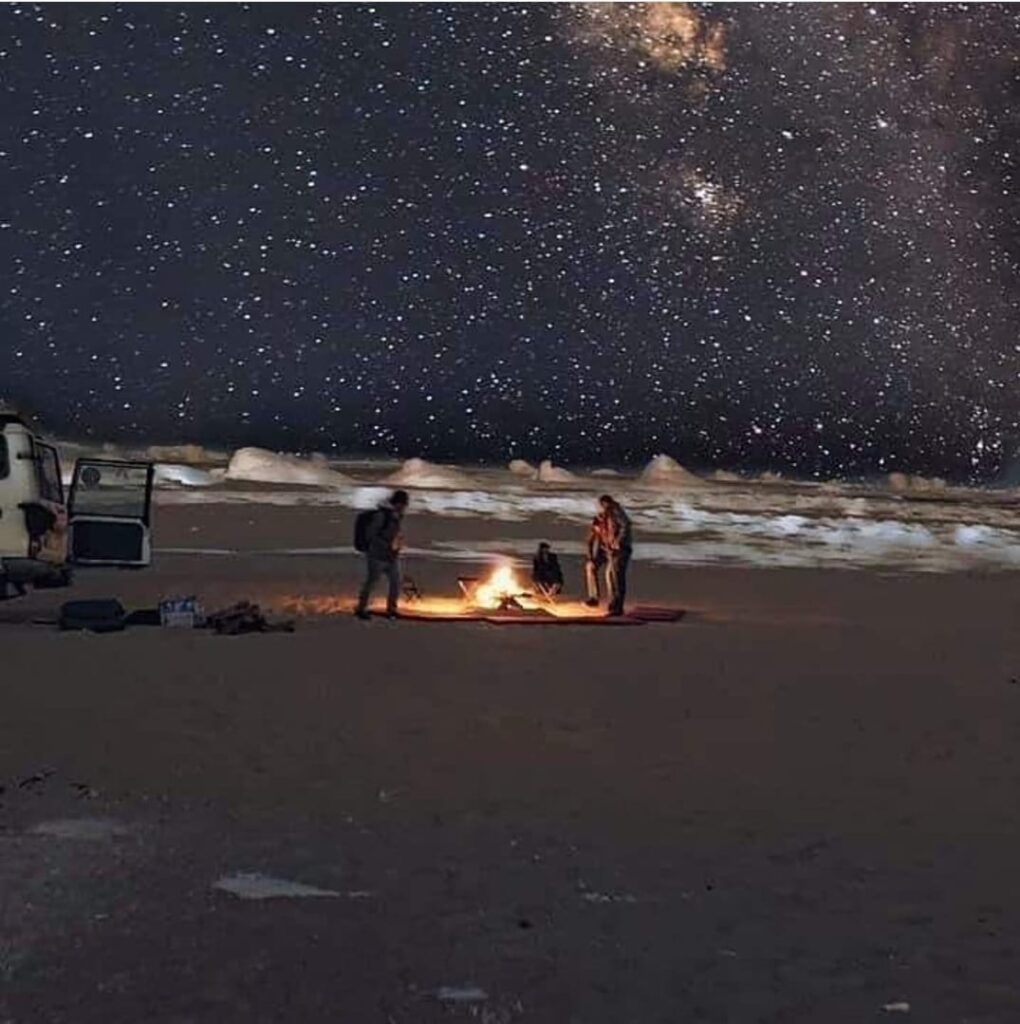
After vehicles stop moving and dinner finishes, the desert becomes exceptionally quiet.
On clear nights, stars dominate the sky.
There are no buildings surrounding the camp.
No neon hotel signs.
No Cairo traffic.
Just desert.
That’s why travelers who only visit the formations during daylight miss an important part of the experience.
Which Is Better for Stargazing?
Darkness matters more than whether somebody calls your precise camp area “Old” or “New.”
The broader White Desert offers extremely dark conditions away from settlements.
Your stargazing quality depends on:
Moon phase,
cloud,
dust,
haze,
season,
and artificial light from your own camp.
A bright full Moon can illuminate the chalk beautifully but reduce the visibility of faint stars.
A moonless night gives you a darker sky.
We’ll cover this in depth in our upcoming:
White Desert Stargazing Guide: Milky Way, Stars & Best Night-Sky Conditions.
Can You Visit Both Old and New White Desert in One Trip?
Yes.
And for most first-time visitors, that’s exactly what I’d aim to do.
A normal overnight White Desert itinerary can move through multiple landscapes in a single route.
A broader sequence may look like:
Cairo
↓
Bahariya Oasis
↓
Black Desert
↓
Crystal Mountain
↓
Agabat Valley
↓
Old White Desert areas
↓
New White Desert areas
↓
Camping
↓
Sunrise
↓
Bahariya
↓
Cairo
The exact sequence depends on the route, guide, permits and desert conditions.
But Old and New White Desert are close enough within the wider safari experience that you should not approach them as two separate holidays.
What Else Do You See Before Reaching the White Desert?
This is one of the things first-time visitors often underestimate.
A White Desert safari isn’t five hours of driving followed by one white landscape.
The journey itself contains several major attractions.
Black Desert
The dark-capped hills give you the opposite color palette from the White Desert.
Read our Black Desert Egypt Guide.
Crystal Mountain
A compact mineral-rich geological landmark where exposed crystals create a very different type of stop.
Read our Crystal Mountain Egypt Guide.
Agabat Valley
Large pale cliffs rising from golden desert make Agabat one of the most dramatic panoramic landscapes on the circuit.
Read our Agabat Valley Egypt Guide.
By the time you reach the White Desert itself, you’ve already moved through several completely different geological environments.
How Long Do You Need for Old and New White Desert?
For most travelers coming from Cairo:
2 days / 1 night
is the classic minimum.
That allows enough time to travel through Bahariya and the major desert stops before camping overnight.
It works well when:
your Egypt itinerary is short,
you primarily want the key landscapes,
and you’re comfortable with a fairly full schedule.
Explore the White Desert Overnight Tour from Cairo.
3 days / 2 nights
is better if the desert itself is a major priority.
You gain more time for:
walking,
photography,
sunrise,
sunset,
additional formations,
slower meals,
and less rushed travel.
Explore the White Desert 3 Days Tour from Cairo.
We’ve also compared the formats in our 2-Day vs 3-Day White Desert Tour Guide.
Is a One-Day White Desert Trip Enough?
From Cairo?
It’s not the format I’d choose if your goal is to properly experience both Old and New White Desert areas.
The road journey alone takes significant time.
Egypt’s official tourism portal estimates the drive between Cairo and Bahariya at roughly five hours depending on conditions and transport.
Then you still need desert travel.
A rushed same-day attempt removes:
sunset,
camping,
night sky,
sunrise,
and much of the slow exploration that makes the White Desert worth visiting.
If time is extremely limited and you cannot stay overnight, a different desert destination such as Fayoum may make more practical sense.
How Do You Get to the White Desert from Cairo?
The common route for many international visitors is:
Cairo → Bahariya Oasis
Travel by road.
Bahariya is around 370 km southwest of Cairo according to Egypt’s official tourism authority.
Bahariya → Desert Route
Continue with suitable off-road transportation and local desert guidance.
Black Desert → Crystal Mountain → Agabat → White Desert
The exact route changes according to itinerary and current conditions.
For a full logistics guide, read Cairo to White Desert Egypt.
Can You Visit Old and New White Desert Without a Tour?
Some travelers assume:
“If there is a road nearby, I’ll just rent a car.”
That isn’t how I’d plan the White Desert.
Egypt’s official tourism portal recommends arranging desert excursions through experienced, licensed guides and checking current permits and regulations.
Why?
Because this isn’t simply a navigation problem.
A proper safari involves:
off-road terrain,
vehicle recovery knowledge,
water,
food,
desert navigation,
camping logistics,
current route rules,
protected-area requirements,
and emergency planning.
A pin on Google Maps doesn’t provide any of those.
Is the Old White Desert Better Than the New White Desert?
No useful answer begins with “yes.”
They’re complementary.
Choose the Old White Desert experience for:
dense chalk formations,
walking among unusual shapes,
close photography,
and multiple formations in a relatively concentrated area.
Choose New White Desert sections for:
open scenery,
isolated rock sculptures,
panoramas,
sunset,
and camping atmosphere.
But if you’re already coming all the way from Cairo:
See both.
You don’t need to turn the itinerary into a contest.
Which One Is Better for Families?
Both can work well.
Kids often enjoy identifying shapes in chalk formations.
One sees a mushroom.
Another sees a rabbit.
Someone else sees a chicken.
That makes the landscape surprisingly interactive.
The bigger family considerations are:
drive time,
camping comfort,
toilet arrangements,
heat,
and how long children are comfortable staying in a vehicle.
A private safari can be easier because the group can stop when needed.
Which One Is Better for Couples?
Both.
But open White Desert landscapes combined with sunset and overnight camping are particularly appealing for couples seeking a quieter experience.
The important factor isn’t whether the camp’s technical label is Old or New.
It’s whether the itinerary gives you:
time,
privacy,
good sunset positioning,
and an appropriate camp setup.
Which Is Better for Solo Travelers?
Again, both.
Solo travelers should choose between:
Shared safari
Lower cost and a social experience.
Private safari
More control over:
photography,
timing,
stops,
walking,
and camp style.
If you’re a serious photographer, the ability to say:
“Can we stay here another 25 minutes?”
can be worth more than seeing one additional named rock.
Best Time to Visit Old and New White Desert
The cooler months are generally the easiest for most visitors.
The White Desert is exposed.
There isn’t much natural shade.
During a normal safari, you may spend hours:
driving,
walking,
photographing,
and camping outdoors.
Winter nights can become colder than visitors expect, so don’t pack only lightweight desert clothing.
For month-by-month planning, see our Best Time to Visit White Desert Egypt.
What Should You Pack?
For a typical overnight White Desert trip, bring:
comfortable closed shoes,
sun hat,
sunglasses,
sunscreen,
breathable daytime clothes,
warm nighttime layers,
power bank,
personal medication,
headlamp,
camera protection,
and personal toiletries.
Don’t assume desert equals hot 24 hours a day.
For a full checklist, read our What to Pack for White Desert Egypt.
Are There Toilets and Showers?
It depends on your camping setup.
Traditional desert camping may involve basic wilderness arrangements rather than permanent bathroom blocks.
More elaborate private camps can offer additional facilities.
Ask before booking.
This question deserves enough detail that we’re also covering it separately in our upcoming:
White Desert Camping Toilets, Showers & Facilities: What to Expect.
Never assume the word “camp” means the same thing from one operator to another.
Responsible Travel in Old and New White Desert
The landscape may look endless.
It is still vulnerable.
Egypt’s official environmental management material describes the White Desert as an important natural area containing distinctive geology, biodiversity and protected habitats.
Do not:
break chalk formations,
remove fossils,
collect rocks,
carve names,
leave rubbish,
drive wherever you want,
or assume every empty patch is an approved campsite.
One careless visitor can damage a formation that took thousands or millions of years to develop.
Use photographs as your souvenirs.
How Much Does a White Desert Trip Cost?
There isn’t one universal White Desert price.
Cost depends on:
trip length,
number of travelers,
shared vs private,
Cairo transfers,
4×4 arrangements,
camping equipment,
food,
permits,
entry fees,
and accommodation.
A two-day shared trip cannot be compared fairly with a three-day private safari.
Instead of asking only:
How much?
ask:
What exactly is included?
We’ve broken down the pricing factors in our White Desert Egypt Cost Guide.
Is the White Desert Safe?
The White Desert is remote terrain.
That means trip safety depends heavily on:
qualified local guides,
reliable vehicles,
approved routes,
current access conditions,
water,
communication,
and emergency preparation.
Travel conditions and permit rules can change.
Egypt’s tourism authority advises visitors to confirm permits and desert regulations with authorized guides or travel agencies before excursions.
For more detailed planning, see our White Desert Egypt Safety Guide.
Old White Desert vs New White Desert: Which Should Photographers Prioritize?
If you’re forced to prioritize due to timing:
Photograph Old White Desert for:
dense formation fields,
texture,
multiple subjects,
recognizable mushroom/tent shapes.
Photograph New White Desert for:
isolated forms,
clean horizons,
minimalist compositions,
sunset,
wide landscapes.
But serious photographers should try to structure an itinerary with time in both.
Because the strongest visual story isn’t:
Old or New.
It’s the transition.
Dense sculpture fields become open desert.
White chalk becomes gold under sunset.
Then the rocks become silhouettes.
Then stars replace the blue sky.
That’s the story.
What Most Travelers Get Wrong About the Old and New White Desert
They spend too much energy trying to decide which one is “better.”
That’s like traveling to Luxor and asking whether you should see only temples or only tombs.
The contrast is the point.
Another common mistake is assuming the words Old and New describe geological age.
They don’t function that way in tourism planning.
And the third mistake is treating famous rock names as fixed official monuments with universally agreed coordinates.
They’re natural formations with local nicknames inside a constantly eroding landscape.
Enjoy the shapes.
Don’t turn them into bureaucracy.
A Good 2-Day Old & New White Desert Itinerary
A well-balanced first trip might look like:
Day 1
Early departure from Cairo.
Road transfer to Bahariya Oasis.
Lunch.
Transfer to 4×4.
Black Desert.
Crystal Mountain.
Agabat Valley.
Old White Desert formations.
New White Desert landscapes.
Sunset.
Camp.
Dinner.
Stargazing.
Day 2
Sunrise.
Breakfast.
Additional White Desert formations.
Return toward Bahariya.
Lunch or oasis stop.
Road transfer to Cairo.
Actual itineraries change with:
permissions,
weather,
road conditions,
and safari logistics.
The list is a model, not a guaranteed order.
A Good 3-Day White Desert Itinerary
With an extra day you can slow everything down.
You can spend more time:
photographing formations,
exploring Agabat,
walking,
visiting springs,
watching multiple sunsets or sunrises,
and experiencing quieter desert areas.
That’s the major advantage.
Not necessarily “more attractions.”
More time.
For travelers who hate feeling rushed, three days is often the better format.
So, Old White Desert or New White Desert?
Here’s the simplest answer:
Old White Desert
Great for dense formations and closer exploration.
New White Desert
Great for open landscapes, isolated shapes and camping atmosphere.
Best option
Visit both.
The labels matter far less once you’re actually there.
What you remember afterwards isn’t:
“I crossed from Old administrative zone to New administrative zone at exactly 3:17 PM.”
You remember:
the rocks,
the silence,
the colors,
the sunset,
the stars,
and waking up inside one of Egypt’s strangest landscapes.
Plan Your Old & New White Desert Safari
The best way to experience these landscapes is as part of the complete Western Desert journey.
Start in Cairo.
Reach Bahariya.
Watch dark hills rise from the Black Desert.
Examine the geology of Crystal Mountain.
Drive through the cliffs of Agabat.
Then enter the White Desert itself and watch the landscape transform from one collection of formations into another.
For a complete first experience, explore the White Desert Safari from Cairo.
For the classic camping format, see the White Desert Overnight Tour from Cairo.
For a slower journey, explore the White Desert 3 Days Tour from Cairo.
And for all available routes, browse Egypt Desert Dunes Tours.
White Desert Safari: Cairo, Bahariya Oasis & Camping Adventure
Egypt Desert Dunes Explore the Journey Stop 01 White Desert Swipe photos ‹ › White Desert White Desert White Desert White Desert White Desert…
White Desert Overnight Tour from Cairo
Egypt Desert Dunes Explore the Journey Stop 01 White Desert Swipe photos ‹ › White Desert White Desert White Desert White Desert White Desert…
White Desert 3 Days Tour from Cairo
Egypt Desert Dunes Explore the Journey Stop 01 White Desert Swipe photos ‹ › White Desert White Desert White Desert White Desert White Desert…
Djara Cave and White Desert Safari
Egypt Desert Dunes Explore the Journey Stop 01 White Desert Swipe photos ‹ › White Desert White Desert White Desert White Desert White Desert…
White Desert Camel Safari
Egypt Desert Dunes Explore the Journey Stop 01 White Desert Swipe photos ‹ › White Desert White Desert White Desert White Desert White Desert…
Western Desert Tour from Cairo
Egypt Desert Dunes Explore the Journey Stop 01 White Desert Swipe photos ‹ › White Desert White Desert White Desert White Desert White Desert…
Book Egypt Desert Dunes Tours on Viator
Discover our private White Desert camping adventures and Siwa Oasis experience. Choose your favorite itinerary and complete your reservation securely through Viator.
4-Day Private Camping Tour in the White Desert from Cairo
Go deeper into Egypt's Western Desert with a private four-day camping adventure including spectacular desert landscapes, Black Desert, White Desert, open-air meals and three nights beneath the stars.
2-Day, 1-Night Camping Tour in White Desert from Cairo
Our most compact White Desert adventure for travelers who want to experience the desert from Cairo, explore its unique landscapes and spend an unforgettable night camping beneath the stars.
3-Day Private Camping Tour of White Desert from Cairo
Spend three days exploring the Western Desert, including the Black Desert, Crystal Mountain, Aqabat area and White Desert, with two nights of private desert camping.
Siwa Oasis Trip with Cairo Pick Up
Travel from Cairo to legendary Siwa Oasis on a private four-day journey exploring Siwan culture, desert landscapes, Lake Siwa, traditional sites and some of the oasis's most distinctive attractions.
Explore Egypt's Desert with Egypt Desert Dunes
From a one-night White Desert camping adventure to extended Western Desert and Siwa Oasis experiences, choose the itinerary that matches your travel style and complete your booking through Viator.
Book a Tour or Create Your Own Egypt Experience
Choose one of our ready-made tours or customize your own private journey. Select your destinations, duration and travel style, then send your request directly to Egypt Desert Dunes on WhatsApp.
Book Your Desert Tour
Select your preferred itinerary and send us your travel details. Our team will reply on WhatsApp with availability and the final quote.
Create Your Own Private Egypt Tour
Combine Cairo, Giza, Fayoum, the Western Desert and Siwa in one custom itinerary. Choose the destinations and experiences you want and our team will recommend the best route based on your available days.
FAQ — Old White Desert vs New White Desert Egypt
What is the difference between the Old White Desert and New White Desert? +
The terms are informal tourism and local route labels for different sections of Egypt's wider White Desert landscape. The Old White Desert is commonly associated with denser groups of formations, while New White Desert itineraries often emphasize more open landscapes and isolated chalk sculptures.
Are the Old White Desert and New White Desert two different national parks? +
No. Egyptian government sources describe the White Desert Protected Area as one protected landscape. Old and New White Desert are commonly used safari terms rather than two separate official national parks.
Is the Old White Desert older than the New White Desert? +
The names should not be interpreted as formal geological ages. Both sections belong to an ancient chalk and limestone landscape shaped over very long periods by geological and erosional processes.
Which is better, the Old White Desert or New White Desert? +
Neither is universally better. The Old White Desert can offer denser formations and closer exploration, while the New White Desert is often associated with open panoramas and isolated chalk formations. Most overnight tours can include both.
Which White Desert has Mushroom Rock? +
Mushroom-shaped formations occur throughout the wider White Desert landscape. Tour itineraries do not always use Old and New labels consistently for every named rock, although several itineraries associate mushroom and tent formations with Old White Desert areas and other named mushroom formations with the New White Desert.
Can you visit Old and New White Desert on the same tour? +
Yes. Many overnight and multi-day White Desert safaris include areas described as both Old and New White Desert during the same journey.
Can you camp in the New White Desert? +
Camping is commonly included in White Desert safari itineraries, including areas described by operators as New White Desert. Exact camping locations depend on current protected-area rules, permits and the itinerary arranged by your licensed operator.
How many days do you need for the White Desert? +
Two days and one night are enough for the classic first experience from Cairo, while three days and two nights provide more time for photography, walking, additional landscapes and slower exploration.
Where is the White Desert in Egypt? +
The White Desert lies in Egypt's Western Desert, north of Farafra Oasis. Egypt's official tourism authority places it approximately 40 km from Farafra.
Can you visit the White Desert from Cairo? +
Yes. Many tours travel from Cairo to Bahariya Oasis by road and continue into the desert by appropriate 4x4 vehicles with local guides.
Do you need a guide for the White Desert? +
Travelers should arrange remote White Desert excursions with experienced licensed guides and confirm current permit requirements and access rules before departure.
What is the best time to visit the White Desert? +
The cooler months are generally more comfortable for desert sightseeing and camping. Visitors should still prepare for strong daytime sun and potentially cold desert nights.
Is the New White Desert better for photography? +
The New White Desert's open spaces and isolated formations can be excellent for wide-angle, sunset and minimalist photography. The Old White Desert is equally strong for closer images of dense chalk formations.
Is White Desert camping worth it? +
For many travelers, yes. Camping allows you to experience sunset, the night sky and sunrise instead of seeing the desert only during bright daytime hours.