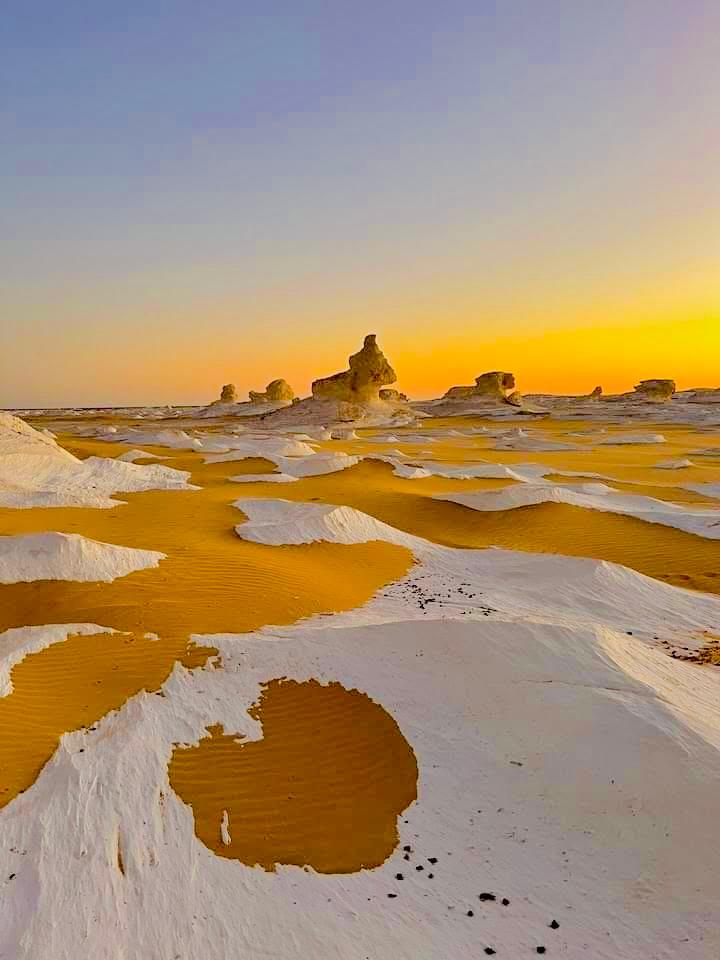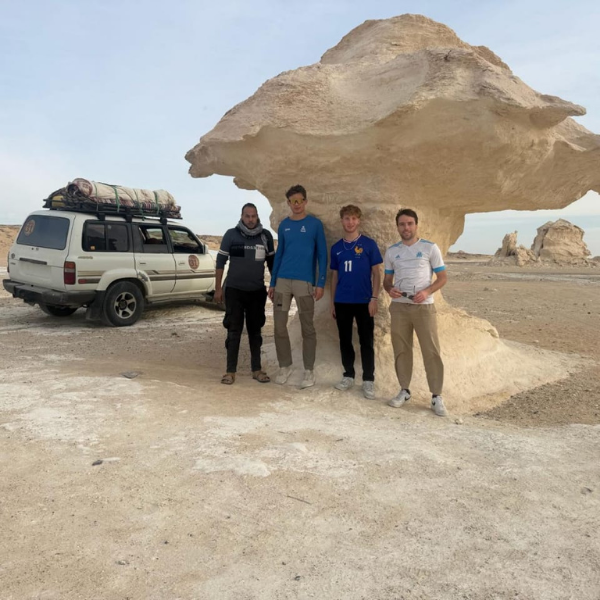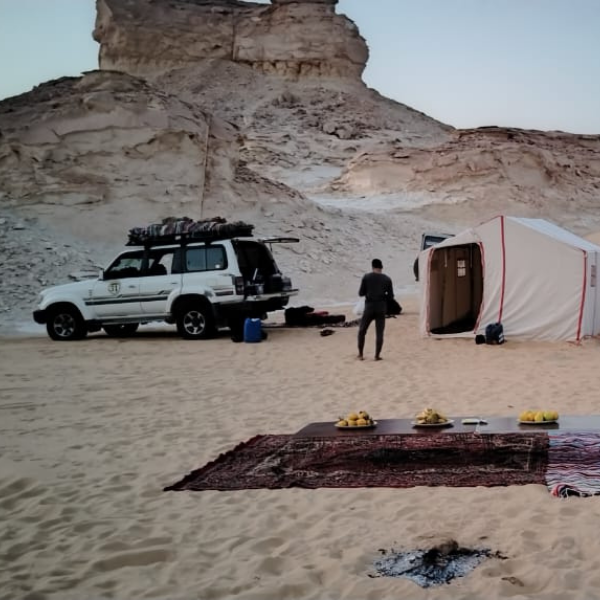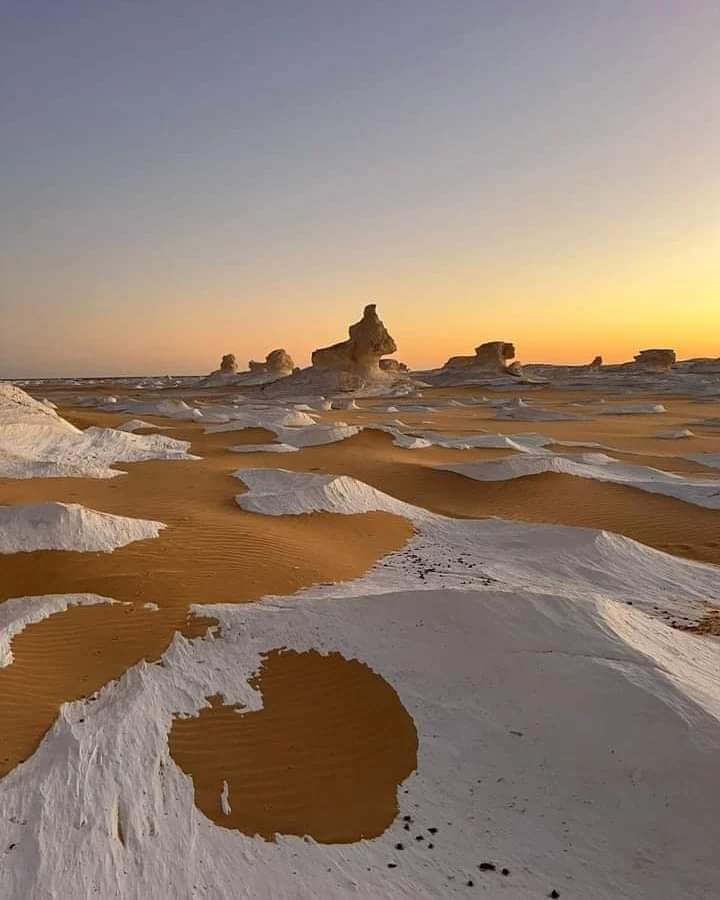
Bahariya & Black Desert Solar Eclipse 2027: Where to View Totality

On August 2, 2027, thousands of eclipse travelers will come to Egypt for one reason:


to stand in the Moon’s shadow during one of the longest total solar eclipses of the century.


But knowing that Egypt lies in the path of totality isn’t enough.


Knowing that Bahariya Oasis lies in the path isn’t enough either.


And simply telling a driver:


“Take me to the Black Desert”

is definitely not enough.

A total solar eclipse is extremely sensitive to location.

Move toward the center of the eclipse path and totality becomes longer.

Move toward the edge and it becomes shorter.


Move outside the boundary completely and — even if 99% of the Sun disappears — you no longer experience totality at all.


That’s why choosing a Bahariya eclipse viewing location requires much more precision than choosing a normal desert sightseeing stop.


Current calculations for Al Bawiti, Bahariya’s principal town, give approximately 6 minutes and 18 seconds of totality, with maximum eclipse around 12:53 PM local time. Timeanddate also calculates about 6 minutes 21 seconds for a representative Bahariya Oasis location, showing how even positions within the wider oasis can produce slightly different results.


NASA’s path data shows something even more interesting:


the central line of the eclipse crosses the Western Desert very close to the Bahariya–Black Desert region, where totality approaches roughly 6 minutes 22 seconds. The overall maximum anywhere along the eclipse path reaches approximately 6 minutes 23 seconds.


That makes the wider Black Desert region extremely attractive for eclipse planning.


But the best site isn’t automatically the point with the longest calculated duration.


A successful viewing location also needs:


legal access,

reliable roads,

space for vehicles,

safe ground,

shade,

water,

medical planning,

minimal dust,

and a clear view of the sky.


That’s the real subject of this guide.


For the broader national event first, read Egypt Solar Eclipse 2027: Complete Travel Guide.


For Bahariya itself, see Bahariya Oasis Solar Eclipse 2027.


And for the actual desert itinerary, explore 2027 Egypt Solar Eclipse White Desert Tour.

- Tours Carousel

Black Desert Eclipse 2027 at a Glance

Question

Answer

Date

Monday, August 2, 2027

Eclipse type

Total solar eclipse

Bahariya inside totality?

Yes

Al Bawiti totality

About 6m 18s

Representative Bahariya totality

About 6m 21s

Central-path duration nearby

Around 6m 22s

Maximum around Al Bawiti

About 12:53 PM

Black Desert inside totality?

Significant parts of the wider region are inside the path

Farafra total?

No — partial eclipse

Best viewing strategy

Approved site inside totality, ideally well away from the path edge

Need precise GPS?

Absolutely

Need solar glasses?

Yes during every partial phase

Why the Black Desert Is Interesting for the 2027 Eclipse

The Black Desert lies within the broader Western Desert landscape associated with Bahariya.


Egypt’s official tourism authority describes Al-Bahariyya as approximately 370 km southwest of Cairo and promotes it as the gateway to both the Black and White Deserts.


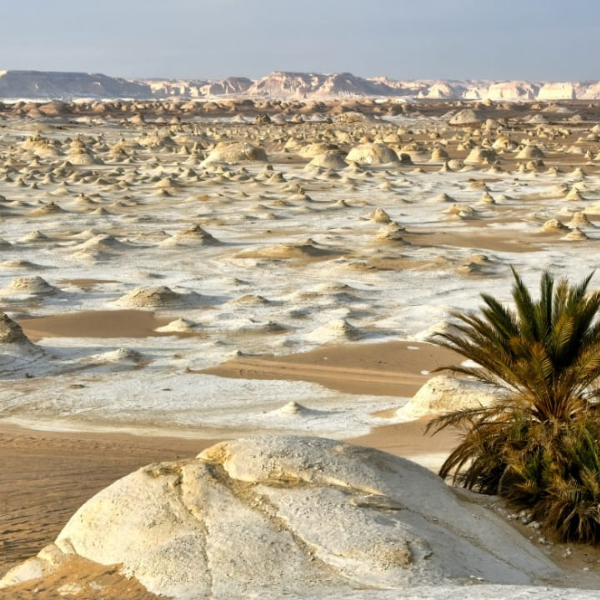
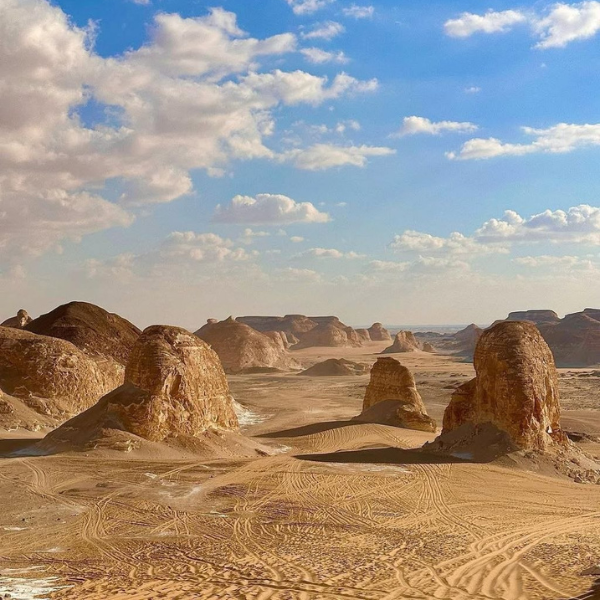
The Black Desert itself is known for dark-capped hills rising from lighter desert terrain.


That creates an extraordinary setting for an eclipse.


Imagine:


a high midday Sun,

a black lunar disk moving across it,

the light fading,

dark hills surrounding the viewing site,

and then more than six minutes of totality.


Astronomically, however, the attraction is even stronger.


NASA’s published eclipse-path coordinates show the centerline sweeping across Egypt’s Western Desert with central durations around 6:22–6:23 as the shadow moves eastward. Near longitudes associated with Bahariya and the Black Desert, the eclipse is already extremely close to maximum global duration.


That makes this region more than a scenic alternative to Luxor.


It is genuinely excellent eclipse geometry.

Is the Black Desert Inside the Path of Totality?

Much of the relevant Bahariya/Black Desert region is, yes.


But this sentence needs a giant asterisk:


The Black Desert is a region, not one GPS pin.


That distinction is critical.


Different websites sometimes talk about “the Black Desert” as though it were one viewpoint.


In reality, it covers a broader zone of dark hills and desert landscape between Bahariya and the White Desert route.


Therefore:


one point can receive slightly longer totality,

another slightly shorter,

and a sufficiently distant point farther south will eventually approach and cross the totality boundary.


NASA explains that observers must be between the northern and southern path limits to experience totality at all; the central red line marks the longest-duration portion of the shadow.


So our rule for 2027 should be:


Never advertise a generic “Black Desert viewing point” without calculating the exact coordinates.

Why Al Bawiti Is Such a Useful Reference

Al Bawiti gives us a reliable, recognizable reference location.


Timeanddate currently calculates:


Partial eclipse begins: approximately 11:29 AM
Maximum eclipse: approximately 12:53 PM
Partial eclipse ends: approximately 2:15 PM
Totality: approximately 6 minutes 18 seconds
Magnitude: approximately 1.034.


Those figures prove something important:


Bahariya isn’t merely touching the edge of totality.


It’s comfortably inside.


You’re already getting more than six minutes of darkness in Al Bawiti itself.


That means you don’t need to chase every final second at the expense of operational safety.

Can You Get Longer Totality Than Al Bawiti?

Potentially, yes.


Timeanddate gives another representative Bahariya Oasis location approximately 6 minutes 21 seconds of totality.


NASA’s central-line data in this section of Egypt approaches roughly 6 minutes 22 seconds.


So moving toward a well-selected position nearer the centerline can add a few seconds compared with central Al Bawiti.


But this is where eclipse tourism can become silly.


Imagine choosing between:


Site A


6 minutes 18 seconds
Flat ground
Easy 4×4 access
Shade
Emergency vehicle access
Minimal dust
Approved permits


and:


Site B


6 minutes 22 seconds
Difficult sand
Poor road access
No facilities
Uncertain permissions
Vehicles likely to create dust


Site A might be the dramatically better eclipse location.


Four seconds is not worth sabotaging the entire operation.

Centerline vs Path Edge: Why It Matters

The eclipse shadow is not equally wide in terms of duration.


At the centerline:


totality lasts longest.


As you travel toward either edge:


totality gradually becomes shorter.


At the exact edge:


totality becomes essentially zero.


Cross the boundary:


you have a partial eclipse.


NASA’s path across Egypt is roughly 256–258 km wide through much of the country.


That’s a huge band.


So you do not need to stand exactly on the red centerline to enjoy extraordinary totality.


In fact, Bahariya demonstrates this perfectly:


Al Bawiti isn’t sitting precisely on the theoretical central line, yet still receives approximately 6:18.


The correct strategy is therefore:


get comfortably inside the path, then optimize logistics.


Not:


risk everything to gain two extra seconds.

Where Should You View the Eclipse Near Bahariya?

There are three practical types of locations to think about.


Option 1: Al Bawiti or Oasis-Edge Viewing Site

This is the easiest operational option.


Advantages include:


shorter transfers from accommodation,

better access,

easier emergency planning,

less dependence on difficult off-road driving,

and approximately 6 minutes 18 seconds of totality at the town reference point.


For travelers whose main priority is a safe, organized viewing event rather than feeling completely isolated, an approved site around the broader oasis could be excellent.


Main disadvantage


You may have:


more people,

buildings,

local traffic,

and artificial infrastructure.


Photographers wanting pure wilderness foregrounds may prefer a desert location.

Option 2: Approved Black Desert Viewing Site

This is probably the most visually exciting option.


A carefully selected site in the Black Desert could combine:


near-centerline eclipse geometry,

a dramatic Western Desert landscape,

open sky,

and minimal urban development.


Some points in this wider corridor can potentially approach central-line durations around 6:22, depending on exact coordinates.


But this option requires significantly more operational planning.


You need to know:


Can buses or 4x4s reach the site?

Is access approved?

Is the ground stable?

How much dust will vehicles produce?

Can everyone leave safely afterwards?

Is there room for tripods?

Can temporary shade be installed?

Can emergency support reach the group?

The landscape might be perfect.

The logistics still have to work.

Option 3: A Site Between Bahariya and the Main Safari Landscapes

A third option is an approved open-desert site that doesn’t need to sit beside a famous Black Desert hill.


From a pure eclipse perspective, this can sometimes be the smartest choice.


A featureless flat desert area may provide:


better parking,

less dust,

excellent sky visibility,

simpler crowd management,

and safer camera setup.


Remember:


the goal on August 2 isn’t to collect sightseeing landmarks.


It’s to see totality.


The dramatic landscapes can be explored before and after Eclipse Day.

Where Should You NOT Automatically View the Eclipse?

Farafra


This is the most important warning.


Farafra is associated strongly with White Desert tourism.


But Timeanddate currently calculates no totality in Farafra.


Instead:


Partial eclipse begins: around 11:28 AM
Maximum: around 12:53 PM
Magnitude: approximately 0.994
Total phase: none.


That’s extremely close to complete coverage.


But 99.4% is still not totality.

Why 99.4% Is Not "Basically Total"

Because the last fraction of visible photosphere is incredibly bright.


At 99.4%, the Sun still isn’t fully covered.


You do not get the same:


corona visibility,

midday darkness,

totality experience,

or safe naked-eye viewing period.


This is why eclipse travelers sometimes drive hundreds of kilometers just to move from 99% to 100%.


For the August 2027 event:


Bahariya:


total.


Al Bawiti:


total.


Many suitable Black Desert locations:


total.


Farafra:


partial.


That one distinction can make or break an entire eclipse trip.

What About the White Desert?

Same problem.


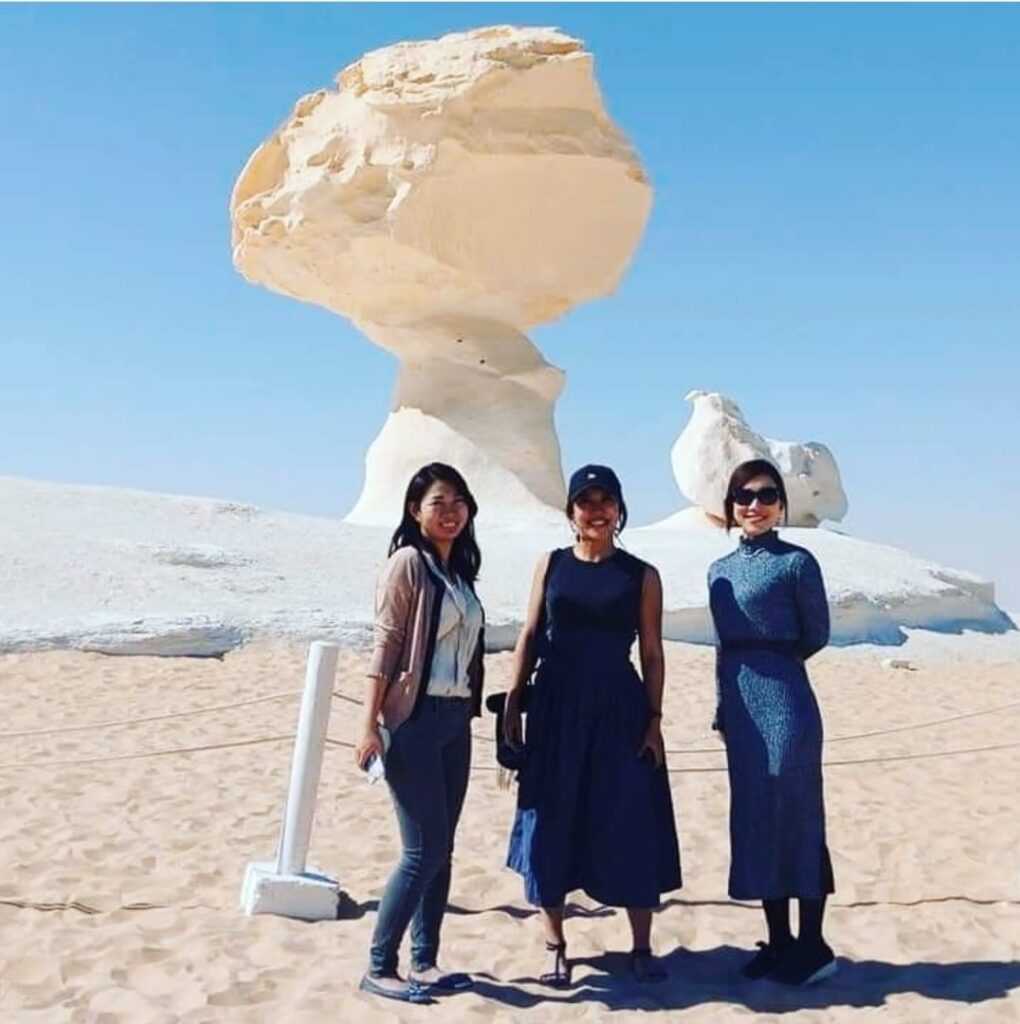
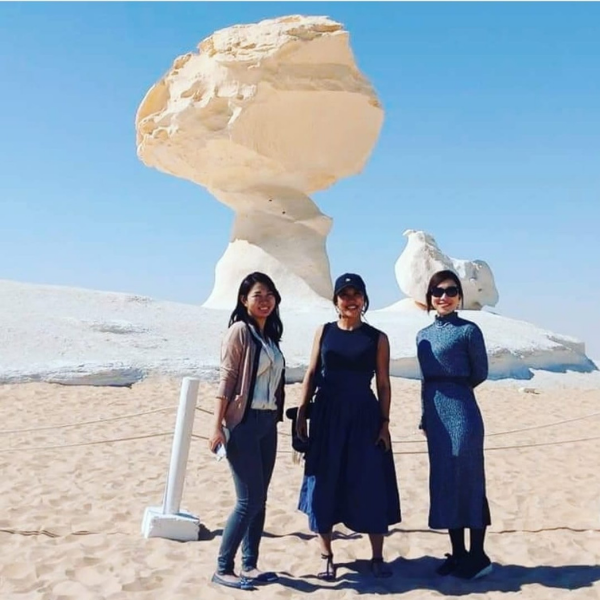
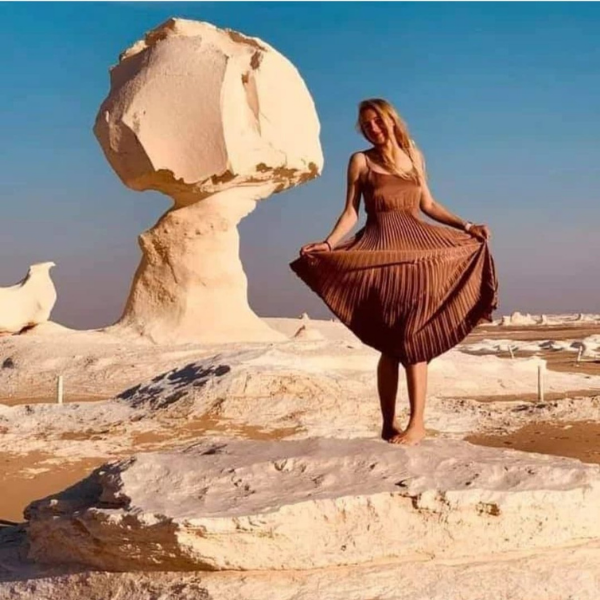
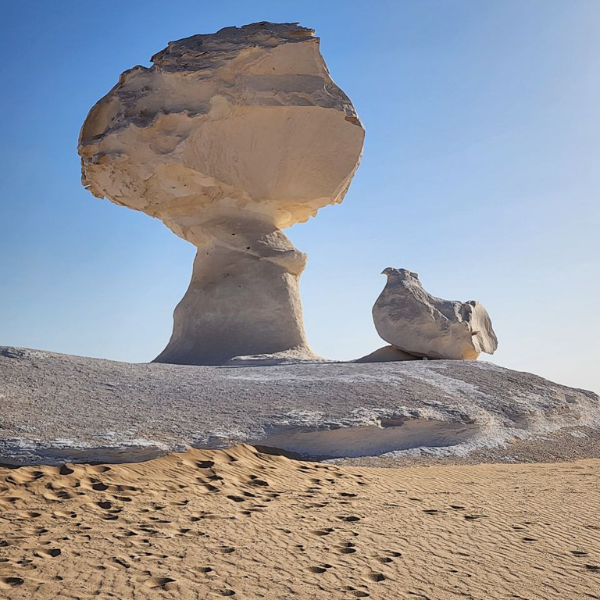
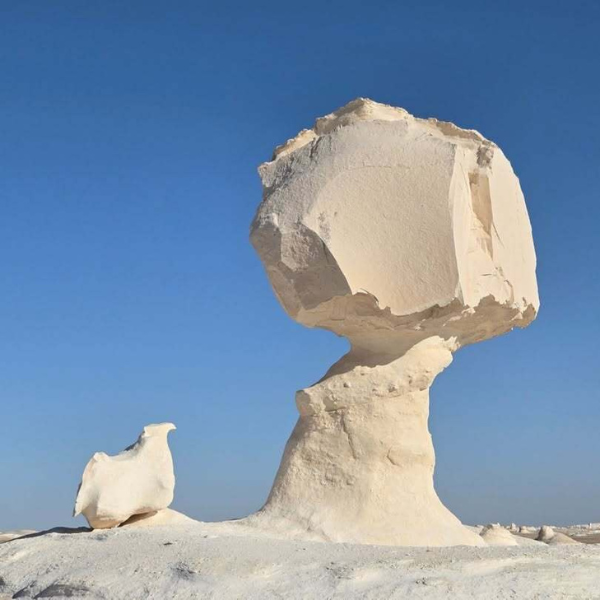
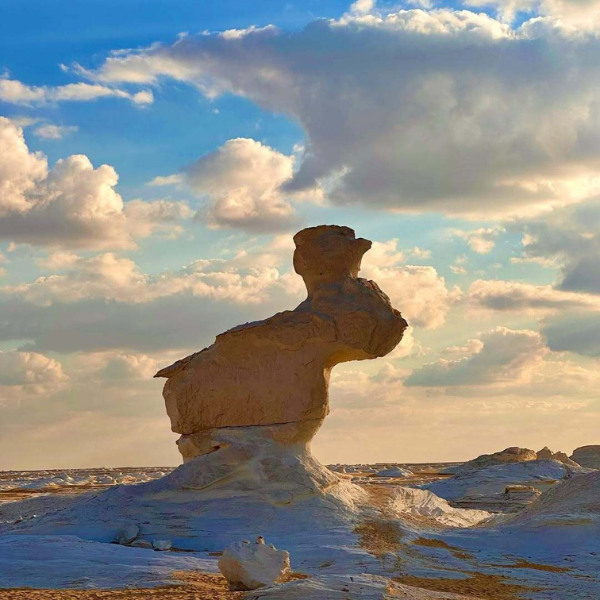
The words White Desert Eclipse Tour do not mean you should automatically stand beside Mushroom Rock at 12:53 PM and expect six minutes of totality.


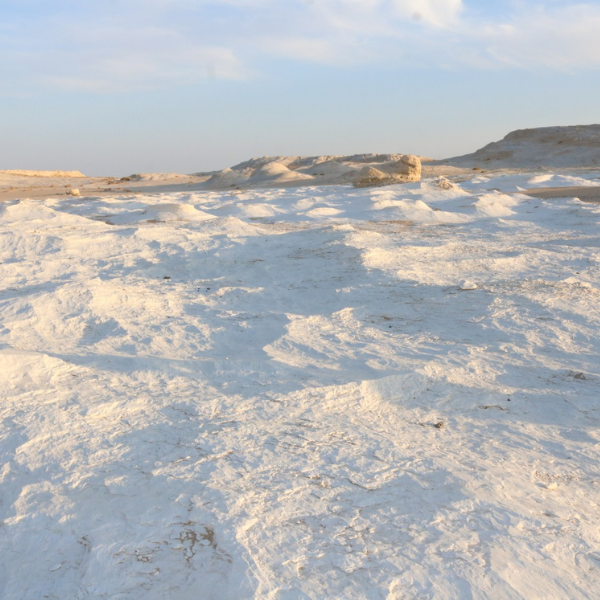
The White Desert extends across a broad area associated with Farafra.


Because Farafra itself is outside the totality path, the itinerary needs to separate two ideas:


Eclipse viewing


from an exact location inside the path.


White Desert exploration


before or after the event.


That’s how our itinerary should be marketed accurately.


The White Desert remains a major part of the experience.


It just doesn’t automatically become the eclipse observation site.


Explore the destination through White Desert Egypt Guide.

The Best 2027 Strategy: Bahariya for Totality, White Desert for Adventure

This is the strongest overall trip structure.


Instead of forcing one location to do everything:


use Bahariya/Black Desert for astronomy,


then use the White Desert route for travel experience.


For example:


Cairo

↓

Bahariya Oasis

↓

Eclipse viewing location inside totality

↓

Black Desert

↓

Crystal Mountain

↓

Agabat Valley

↓

White Desert

↓

Camping

↓

Return


This gives travelers both:


a properly planned total eclipse


and


a complete Western Desert adventure.

How High Will the Sun Be During Totality?

Very high.


This is one of the most useful details for choosing a site.


NASA’s centerline data around the Bahariya section of Egypt places the Sun at roughly 78–79 degrees altitude during this portion of the eclipse.


That means the Sun will be almost overhead.


This changes the normal eclipse-location checklist.


For a low-altitude eclipse, you desperately need a perfect unobstructed horizon.


In Bahariya?


The horizon is less critical because the Sun is extremely high.


Instead, focus more on:


open overhead sky,

shade,

heat management,

dust,

safe tripod positioning,

and vehicle access.


Photographers also need to remember that aiming a long lens almost overhead can be physically awkward.


Practice beforehand.

Will Mountains Block the Eclipse?

Ordinary surrounding hills are unlikely to block a Sun that high in the sky.


That’s good news for the Black Desert.


Dark hills can therefore become excellent foreground elements without necessarily threatening solar visibility.


But photographers planning compositions need to distinguish:


telephoto solar photography


where the Sun itself fills the frame,


from


wide landscape photography


where hills, people and eclipse-darkened scenery become part of the image.


You may want two cameras.

The Black Desert Could Be Better Than a City for Wide-Angle Photography

Luxor has temples.


Bahariya has the Western Desert.


Different story.


In the Black Desert, photographers can potentially capture:


eclipse darkness over dark hills,

360-degree twilight colors,

silhouetted 4×4 vehicles,

people watching totality,

and dramatic changes in desert light.


During a total solar eclipse, some of the most memorable photographs aren’t close-ups of the corona.


They’re images showing what totality did to the world around the observer.


The Black Desert offers an unusually strong setting for that type of work.

But Dust Could Ruin the View

This is one of the practical issues that glamorous eclipse maps don’t show.


Imagine 30 vehicles arriving on an unpaved track fifteen minutes before totality.


Every vehicle produces dust.


Now imagine that dust drifting across your viewing site.


Not ideal.


A good site-management plan should consider:


vehicle approach direction,

parking location,

distance from observers,

wind direction,

arrival time,

and whether vehicles should remain stationary well before critical phases.


This could matter just as much as cloud.

What About Cloud?

Long-range climate statistics for Bahariya are encouraging.


Timeanddate currently reports that August 2 has been cloudy 0% of the time in its historical Al Bawiti dataset since 2000.


But that’s climatology.


It is not a weather forecast.


August 2, 2027 could still have:


high cloud,

dust,

haze,

or unusual atmospheric conditions.


Actual weather models become meaningful only much closer to Eclipse Day.


So the plan should have two levels:


Long-term


choose a climatologically promising region.


Short-term


monitor actual forecasts and dust conditions.


We’ll cover this properly in the planned article:


Egypt Solar Eclipse 2027 Weather & Cloud Prospects: Bahariya, Siwa & Luxor.

How Important Is a Backup Viewing Site?

Very.


Even in a desert climate.


A serious eclipse operation should ideally have:


Primary Site A


and


Backup Site B.


Potentially even C.


But the backup needs to be realistic.


It must also have:


legal access,

correct permits,

safe roads,

and confirmed totality.


There’s no point creating a theoretical backup 150 km away if you can’t legally move the group there on Eclipse Morning.


Backup planning should happen before August 2.

How Far Can You Move on Eclipse Morning?

Less easily than many independent eclipse chasers imagine.


A solo traveler in a rental car can sometimes change location quickly.


A Western Desert expedition may involve:


multiple 4x4s,

guests,

guides,

permits,

equipment,

water,

food,

shade structures,

camera gear,

and checkpoint procedures.


Moving 100 people isn’t the same as moving two people.


Therefore the final location needs a balance between:


meteorological flexibility


and


operational certainty.

Current Permit Requirements Matter

As of October 2026, current UK government travel guidance says tourists entering Bahariya Oasis, Farafra, the White Desert and Black Desert must arrange permits in advance and use an official guide. It also highlights limited mobile reception and poor medical facilities in these desert areas.


Its broader safety guidance also states that off-road travelers should use a qualified guide and obtain required Ministry of Interior permits.


Those requirements could change before August 2027.


So:


don’t lock marketing copy into claims that a particular remote viewpoint will definitely remain accessible.


Sell the experience as:


a carefully selected approved viewing site inside the path of totality.


That’s more accurate and operationally safer.

Don't Use the Bahariya–Siwa Road as an Eclipse Backup Without Checking

Current FCDO guidance specifically advises against all but essential travel on the road between Al Bawiti and Siwa, saying the road is closed and has military checkpoints.


That matters because eclipse maps might tempt travelers to think:


“If Bahariya has cloud, we’ll just drive toward Siwa.”


That’s not currently a realistic casual backup plan.


Conditions could change by August 2027.


But the principle remains:


astronomical maps don’t know road restrictions.

How Early Should You Reach the Viewing Site?

Hours early.


Not minutes.


The partial eclipse in Al Bawiti begins around 11:29 AM, with maximum around 12:53 PM.


For an organized expedition, I’d want the group completely settled long before the first partial phase.


That allows time for:


parking,

shade setup,

toilets,

water,

camera tripods,

solar-filter checks,

safety briefing,

and fixing technical problems.


If your telescope mount refuses to work?


You want to discover that at 9:30 AM.


Not 12:49 PM.

Why You Should Not Drive from Cairo on Eclipse Morning

Bahariya is around 370 km southwest of Cairo according to Egypt’s official tourism authority.


An ordinary road trip can already take several hours.


Now add:


eclipse traffic,

checkpoints,

group logistics,

and a once-only astronomical deadline.


No thanks.


Travelers should arrive in Bahariya before Eclipse Day.


Ideally at least one day earlier.


For larger expeditions, two days gives even more operational margin.

Recommended Eclipse-Day Timeline

A sample timeline could look something like this:


7:00–8:00 AM


Breakfast.


8:00–9:00 AM


Depart accommodation.


9:00–10:00 AM


Reach viewing site.


10:00 AM


Site fully established.


10:00–11:00 AM


Photography setup, safety briefing, hydration.


11:29 AM


Partial eclipse begins around the Al Bawiti reference area.


~12:50 PM


Totality begins depending on exact site.


~12:53 PM


Maximum eclipse.


~12:56 PM


Totality ends depending on location.


2:15 PM


Partial eclipse finishes around the Al Bawiti reference.


Exact contact times must be calculated for the final GPS location.

What Makes a Perfect Black Desert Eclipse Site?

Here’s the checklist I’d use.


  1. Deep inside the path of totality

Not right beside the boundary.


  1. Near enough to the centerline

Long totality is nice, but not at any cost.


  1. Legal and permitted

Non-negotiable.


  1. Reliable vehicle access

You need to get everybody there — and back.


  1. Flat viewing area

Important for telescopes and tripods.


  1. Minimal dust

Keep parking away from observation equipment.


  1. Space

Nobody wants somebody else’s tripod in their lens.


  1. High-sky visibility

The Sun will be very high.


  1. Shade

It’s August.


  1. Drinking water

Lots of it.


  1. Toilet plan

Especially for a group spending several hours on site.


  1. Communications

Satellite communication or whatever support structure the operator deems appropriate can matter where cellular reception is limited.


  1. Emergency access

A remote spot that an ambulance or support vehicle cannot approach deserves serious thought.


  1. Backup option

Weather and dust remain uncertainties.


That’s a better definition of the “best viewing location” than simply asking which GPS point gives the longest number on an eclipse calculator.

Eye Safety During the Eclipse

This is essential.


During every partial phase:


use proper solar viewing protection.


NASA says safe eclipse viewers should comply with ISO 12312-2 and warns that ordinary sunglasses — no matter how dark — are unsafe for direct solar viewing.


You can remove eye protection only during true totality, when the Moon completely covers the bright solar photosphere.


The moment even a small part of the Sun returns:


glasses back on.

Cameras Need Solar Filters Too

Eclipse glasses on your face don’t protect a camera.


NASA warns that cameras, telescopes and binoculars require proper solar filters attached to the front of the optics while any portion of the bright Sun remains visible.


Looking through an unfiltered telephoto lens is especially dangerous because the optics concentrate sunlight.


Practice before Egypt.


Don’t make Eclipse Day your first experiment.

What Should Photographers Bring?

For serious eclipse photography:


DSLR or mirrorless camera,

telephoto lens,

front-mounted solar filter,

strong tripod,

remote shutter,

multiple batteries,

multiple memory cards,

lens cloth,

dust protection,

and a rehearsed exposure sequence.


For environmental photography:


add a second camera with a wider lens.


That’s where Black Desert scenery becomes particularly useful.

Should You Photograph or Just Watch?

Both.


But if this is your first total eclipse:


don’t spend six minutes staring at the back of a camera.

Automate what you can.

Practice everything before the trip.


Then during totality:


look up.

Look around.

Watch the horizon.

Notice the temperature.

See how the desert changes.


A perfect RAW file won’t replace the memory of actually experiencing totality.

Heat Planning Is Critical

August 2 is summer.


That’s obvious, but easy to underestimate when all the planning focuses on cloud statistics.


The group could be outside for hours around midday.


NASA recommends sunscreen, hats and protective clothing for eclipse observers because the partial phases can involve long periods of direct sunlight.


For Bahariya, add:


water,

shade,

electrolytes,

rest,

and heat-aware scheduling.


A scientifically perfect viewing site that leaves guests overheating isn’t a good viewing site.

What About Children?

Children can absolutely experience the eclipse.


But the tour must handle:


eye protection,

supervision,

heat,

waiting time,

toilets,

water,

and boredom before totality.


NASA specifically recommends supervising children using solar viewers.


Families may therefore prefer a more developed Bahariya-edge viewing site over an extremely remote Black Desert point.


The best location depends on the audience.

Black Desert vs Al Bawiti: Which Is Better?

Here’s the practical comparison.

Factor

Al Bawiti / Oasis Edge

Black Desert

Totality

~6m18s at Al Bawiti

Could approach ~6m22s at suitable locations

Hotels nearby

Better

Limited / none

Wilderness

Lower

Excellent

Vehicle logistics

Easier

More complex

Photography setting

Oasis / open desert

Dramatic dark hills

Dust risk

Traffic dependent

4×4 dependent

Emergency access

Easier

Site-specific

Permits

Required planning

Required planning

Best for

Convenience & families

Adventure & photography

There’s no universal winner.


For a specialist photography expedition?


Black Desert could be spectacular.


For a large mixed-age group?


A carefully selected site closer to Bahariya may be smarter.

Black Desert vs Luxor

Luxor will likely be the headline destination for the eclipse.


It offers:


approximately 6 minutes 22+ seconds of totality,

major hotels,

air access,

famous temples,

and huge tourism infrastructure.

Bahariya/Black Desert offers:


similar astronomical duration,

much smaller-scale tourism,

desert landscapes,

and a safari experience.


This article isn’t trying to claim one is “better.”


They’re different products.


Luxor is:


eclipse + ancient Egypt.


Bahariya is:


eclipse + Western Desert expedition.


For Egypt Desert Dunes, that’s exactly the positioning we want.

Should You Chase the Exact Maximum Eclipse?

Probably not.


The overall maximum lasts about 6:23.


Al Bawiti already gives roughly 6:18.


We’re talking about a difference of around five seconds.


Five.


Seconds.


Would I sacrifice:


road quality,

shade,

safety,

legal access,

or a good campsite


for five seconds?


Absolutely not.


Choose an excellent site comfortably inside totality.


Then enjoy the six-plus minutes you already have.

Sample 5-Day Eclipse + Black & White Desert Itinerary

Day 1 — Cairo to Bahariya


Travel west from Cairo.


Arrive well ahead of Eclipse Day.


Explore the oasis and rest.


Day 2 — Bahariya & Eclipse Preparation


Visit selected local attractions.


Review viewing-site access.


Test camera equipment.


Confirm weather and dust forecast.


Early night.


Day 3 — August 2, 2027: Total Solar Eclipse


Transfer early to the approved site.


Set up shade and observation equipment.


Watch the partial eclipse.


Experience more than six minutes of totality depending on the exact location.


Remain on site until the partial phase and departure logistics allow safe movement.


Celebrate.


Day 4 — Black Desert, Crystal Mountain & Agabat


Now switch from astronomy to desert adventure.


Explore the Black Desert properly without Eclipse-Day pressure.


Continue through Crystal Mountain Egypt.


Then explore Agabat Valley Egypt.


Continue toward White Desert camping.


Day 5 — White Desert Sunrise & Cairo


Wake among chalk formations.


Explore the wider White Desert.


Return through Bahariya.


Continue toward Cairo.


That’s a much better itinerary than trying to squeeze the entire desert safari around the eclipse itself.

Why the Eclipse Should Control Eclipse Day

Normal sightseeing rules don’t apply on August 2.


If a group is running late and someone asks:


“Can we still stop at Crystal Mountain for 30 minutes?”


The answer should be:


not if it threatens the eclipse schedule.


Crystal Mountain will still exist tomorrow.


Totality won’t.


The entire Eclipse Day itinerary should be built backwards from totality.


Everything else is secondary.

Responsible Viewing in the Black Desert

The eclipse could bring unusually large numbers of people into remote landscapes.


That creates environmental risks.


Don’t:


leave eclipse glasses behind,

leave plastic bottles,

drive randomly across fragile ground,

damage formations,

build unauthorized camps,

or abandon equipment.


Pack out everything.


A once-in-a-century tourism event shouldn’t create a decade of rubbish.


For the landscape itself, see Black Desert Egypt Guide.

Final Verdict: Where Should You Watch the 2027 Eclipse in Bahariya?

The best answer today is not one permanent GPS coordinate.


It’s this:


Choose a legal, approved site inside the path of totality in the Bahariya/Black Desert region, comfortably away from the path boundary and as close to the centerline as practical without sacrificing logistics.


Al Bawiti already offers approximately 6 minutes 18 seconds.


Other Bahariya locations can reach approximately 6 minutes 21 seconds.


NASA’s central-line duration across this part of Egypt reaches roughly 6 minutes 22 seconds.


That means the region gives us flexibility.


We don’t have to choose between:


astronomy

and

safety.


The final site should be selected using:


precise GPS calculations,

2027 permits,

road access,

weather,

dust forecasts,

group size,

and current local regulations.


Then lock it in.


For the complete eclipse strategy, read Egypt Solar Eclipse 2027 Complete Travel Guide.


For Bahariya-specific planning, see Bahariya Oasis Solar Eclipse 2027.


And for travelers who want to combine totality with the Black Desert, Crystal Mountain, Agabat and White Desert, explore 2027 Egypt Solar Eclipse White Desert Tour.

✓ Available on Viator

Book Egypt Desert Dunes Tours on Viator

Discover our private White Desert camping adventures and Siwa Oasis experience. Choose your favorite itinerary and complete your reservation securely through Viator.

✓ Private Tours
✓ Cairo Pickup
✓ Mobile Ticket
✓ English Speaking Team
✓ Book Through Viator
4-Day Private White Desert Camping Tour from Cairo by Egypt Desert Dunes
✓ Book on Viator
Private Tour
White Desert • Bahariya Oasis • Egypt
⏱ 4 Days / 3 Nights ★ 5.0 (4 Reviews)

4-Day Private Camping Tour in the White Desert from Cairo

Go deeper into Egypt's Western Desert with a private four-day camping adventure including spectacular desert landscapes, Black Desert, White Desert, open-air meals and three nights beneath the stars.

Cairo Pickup Private Tour Desert Camping Meals Included
Reference price from
€588 / person*
Check Viator for today's live price
View on Viator →
2-Day 1-Night White Desert Camping Tour from Cairo by Egypt Desert Dunes
✓ Book on Viator
Best Short Trip
White Desert • Black Desert • Egypt
⏱ 2 Days / 1 Night ★ 5.0 (3 Reviews)

2-Day, 1-Night Camping Tour in White Desert from Cairo

Our most compact White Desert adventure for travelers who want to experience the desert from Cairo, explore its unique landscapes and spend an unforgettable night camping beneath the stars.

1 Night Camping Cairo Pickup Breakfast Lunch & Dinner
Reference price from
€197 / person*
Price varies by date and group size
View on Viator →
3-Day Private White Desert Camping Tour from Cairo by Egypt Desert Dunes
✓ Book on Viator
Popular Choice
Black Desert • Aqabat • White Desert
⏱ 3 Days / 2 Nights ★ 5.0 (5 Reviews)

3-Day Private Camping Tour of White Desert from Cairo

Spend three days exploring the Western Desert, including the Black Desert, Crystal Mountain, Aqabat area and White Desert, with two nights of private desert camping.

2 Nights Camping Black Desert White Desert Private Experience
Reference price from
€394 / person*
Check Viator for today's live price
View on Viator →
4-Day Siwa Oasis Trip from Cairo by Egypt Desert Dunes
✓ Book on Viator
Siwa Experience
Siwa Oasis • Western Desert • Egypt
⏱ 4 Days Egypt Desert Dunes • 14 Operator Reviews

Siwa Oasis Trip with Cairo Pick Up

Travel from Cairo to legendary Siwa Oasis on a private four-day journey exploring Siwan culture, desert landscapes, Lake Siwa, traditional sites and some of the oasis's most distinctive attractions.

4 Days Cairo Pickup Siwa Hotel Meals Included
Reference price from
$1,150 / adult*
Check Viator for today's live price
View on Viator →
*Important: Prices shown above are reference “from” prices observed while reviewing the listings and may change based on travel date, number of travelers, availability, currency and Viator pricing. Click “View on Viator” for the current final price before booking.

Explore Egypt's Desert with Egypt Desert Dunes

From a one-night White Desert camping adventure to extended Western Desert and Siwa Oasis experiences, choose the itinerary that matches your travel style and complete your booking through Viator.

Explore Our Tours →
Plan Your Desert Adventure

Book a Tour or Create Your Own Egypt Experience

Choose one of our ready-made tours or customize your own private journey. Select your destinations, duration and travel style, then send your request directly to Egypt Desert Dunes on WhatsApp.

Book Your Desert Tour

Select your preferred itinerary and send us your travel details. Our team will reply on WhatsApp with availability and the final quote.

Choose Your Tour *
Please select a tour and complete your name, travel date and number of travelers.
Your booking request will open directly in WhatsApp. No payment is made through this form.

Create Your Own Private Egypt Tour

Combine Cairo, Giza, Fayoum, the Western Desert and Siwa in one custom itinerary. Choose the destinations and experiences you want and our team will recommend the best route based on your available days.

Which Places Would You Like to Visit? *
Select as many destinations as you like. Egypt Desert Dunes will recommend the best route according to your trip duration.
What Are You Most Interested In?
Please enter your name, number of travelers, trip duration and select at least one destination.
Egypt Desert Dunes will review your selections and send you a customized itinerary and quotation on WhatsApp.

FAQ — Bahariya & Black Desert Solar Eclipse 2027

Will the Black Desert see the total solar eclipse in 2027? +

Yes, suitable locations in the Bahariya/Black Desert region lie inside the August 2, 2027 path of totality. Exact eclipse duration depends on the precise GPS coordinates selected.

How long will totality last in the Black Desert? +

Exact duration depends on location. Al Bawiti receives about 6 minutes 18 seconds, representative Bahariya coordinates can receive around 6 minutes 21 seconds, and nearby central-line locations approach approximately 6 minutes 22 seconds.

What time is the eclipse in Bahariya? +

For Al Bawiti, the partial eclipse begins around 11:29 AM, reaches maximum around 12:53 PM and ends around 2:15 PM local time.

Where is the best place to watch the eclipse in Bahariya? +

The best site should be a legally accessible location comfortably inside the path of totality, with safe road access, open sky, sufficient space, shade, water and minimal dust. The final site should be chosen using precise GPS coordinates and current 2027 permit conditions.

Is Al Bawiti a good eclipse viewing location? +

Yes. Al Bawiti is currently calculated to receive approximately 6 minutes 18 seconds of totality, making it an excellent astronomical reference point. More remote desert locations may offer longer totality or stronger scenery but require additional logistics.

Is the Black Desert better than Al Bawiti for the eclipse? +

The Black Desert may offer a more dramatic wilderness setting and some locations closer to the eclipse centerline. Al Bawiti offers easier accommodation, transport and emergency logistics. The best option depends on the group and final approved viewing site.

Is the White Desert inside the path of totality? +

Not all White Desert-related areas are inside totality. Farafra Oasis is currently calculated to receive a partial eclipse with magnitude approximately 0.994, so White Desert tour itineraries should use a confirmed viewing location farther inside the totality path.

Will Farafra see a total solar eclipse? +

No. Current calculations show a partial eclipse in Farafra on August 2, 2027 rather than totality.

Why should I avoid viewing near the edge of the path? +

Totality becomes progressively shorter toward the path boundary. Remaining comfortably inside the totality zone provides a longer eclipse and reduces the risk of accidentally choosing a location outside totality.

Do I need to be exactly on the centerline? +

No. Al Bawiti already receives more than six minutes of totality despite not being exactly on the centerline. A safe, accessible site a short distance from the centerline can be better than a difficult location providing only a few additional seconds.

How high will the Sun be during totality near Bahariya? +

NASA path data places the Sun roughly 78–79 degrees above the horizon in this part of Egypt around maximum eclipse, meaning the Sun will be very high in the sky.

Will clouds be a major risk in Bahariya? +

Historical cloud data is very encouraging, but climatology cannot guarantee clear weather on August 2, 2027. Actual cloud, dust and haze forecasts should be monitored close to Eclipse Day.

Do I need eclipse glasses? +

Yes. ISO 12312-2 compliant solar viewers should be used throughout all partial phases. They can only be removed during true totality when the bright solar surface is completely covered.

Do cameras need solar filters? +

Yes. Cameras, binoculars and telescopes require appropriate front-mounted solar filters during the partial phases.

Do I need a permit to visit the Black Desert? +

Current travel guidance says tourists entering Bahariya, the Black Desert, White Desert and Farafra need advance permits and an official guide. Requirements should be reconfirmed before travel in August 2027.

Should I drive from Cairo to Bahariya on Eclipse Day? +

That is not recommended for a dedicated eclipse trip. Bahariya is roughly 370 km southwest of Cairo, and travelers should ideally arrive before Eclipse Day to reduce the risk of traffic, checkpoint or road delays.

Can I combine the eclipse with a White Desert safari? +

Yes. One of the strongest itineraries uses Bahariya or a suitable Black Desert location for totality, then explores Crystal Mountain, Agabat Valley and the White Desert before or after Eclipse Day.

Traveler Reviews

What Our Guests Say on Tripadvisor

Real experiences from travelers who explored Egypt’s deserts, oases, and cultural landmarks with Egypt Desert Dunes. Read their Tripadvisor reviews and discover why guests choose us for private desert safaris, camping adventures, and unforgettable Egypt tours.

Leave a Comment

Your email address will not be published. Required fields are marked *