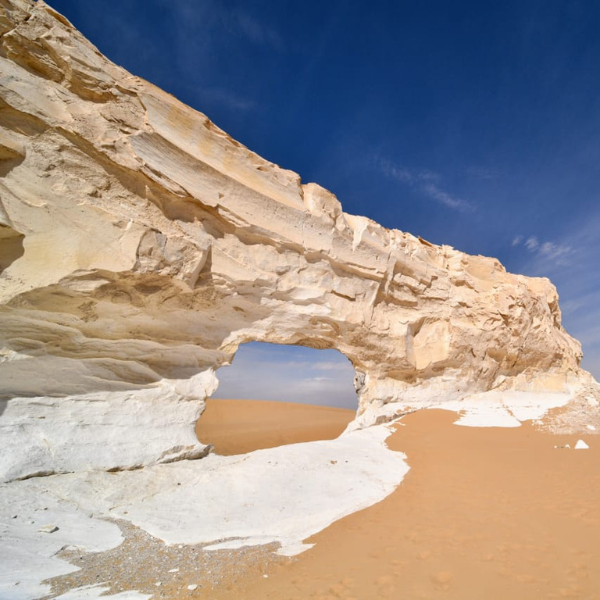
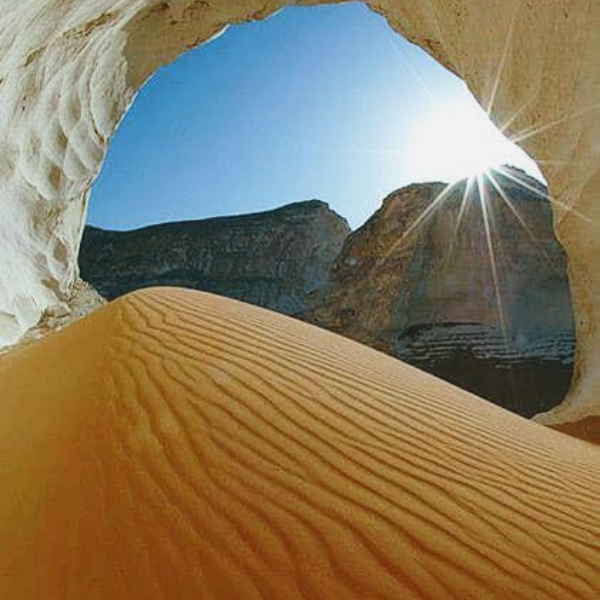
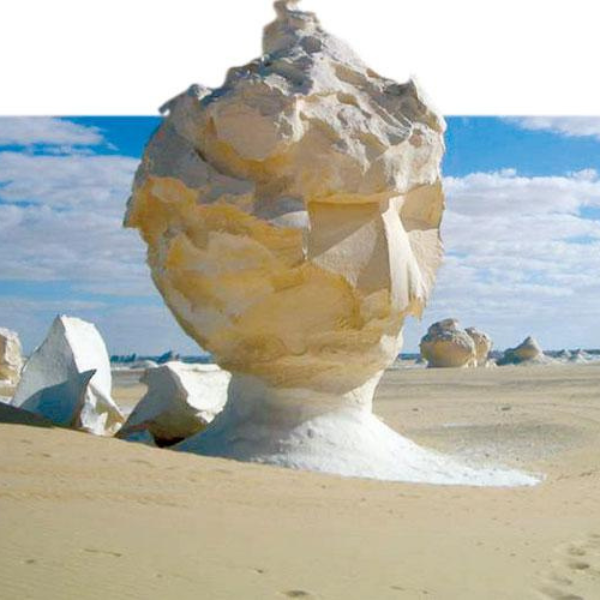
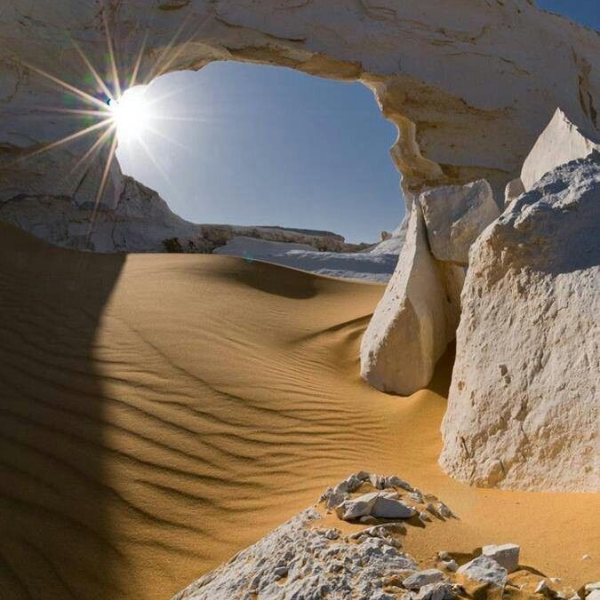
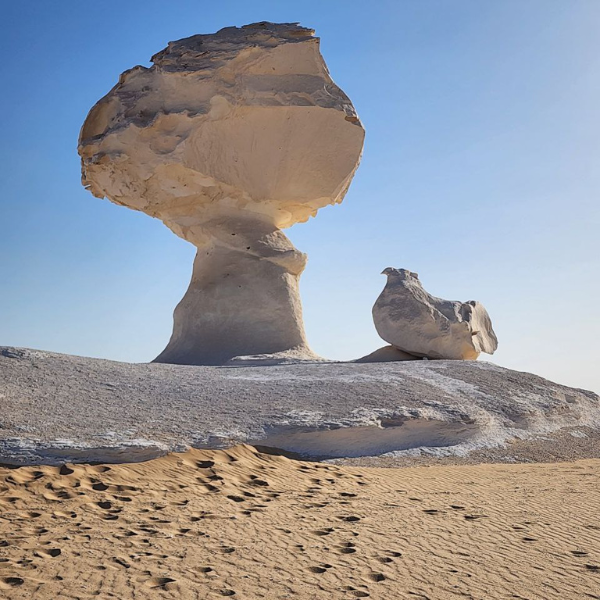
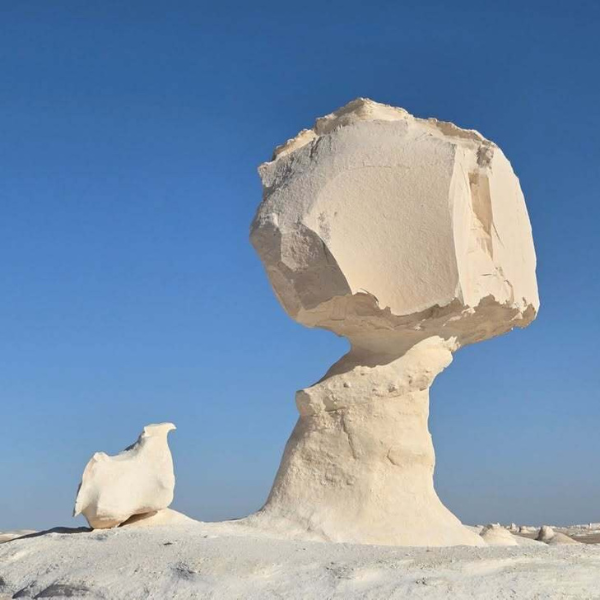
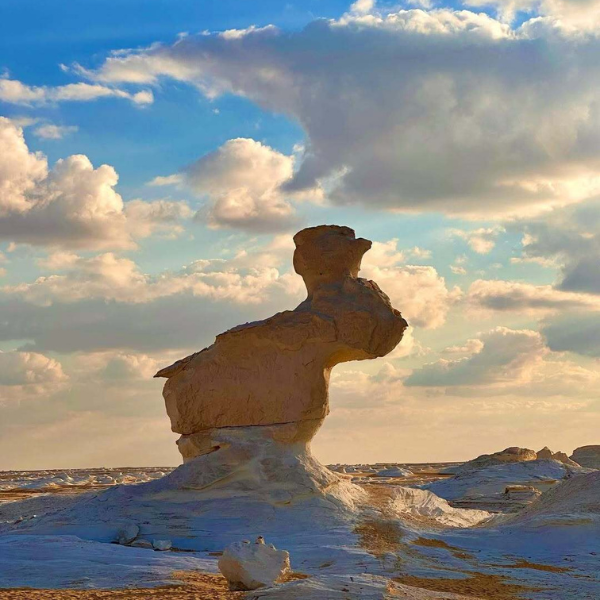
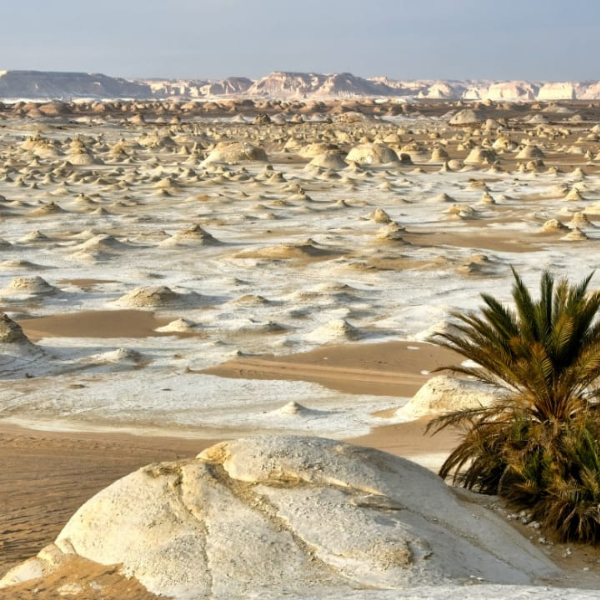
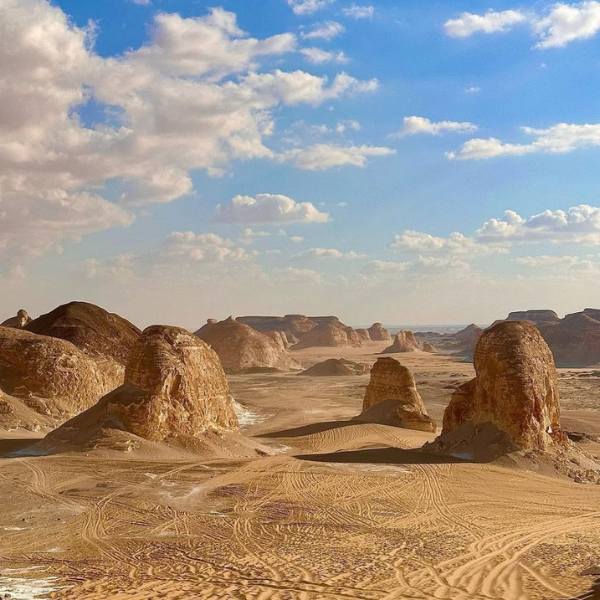
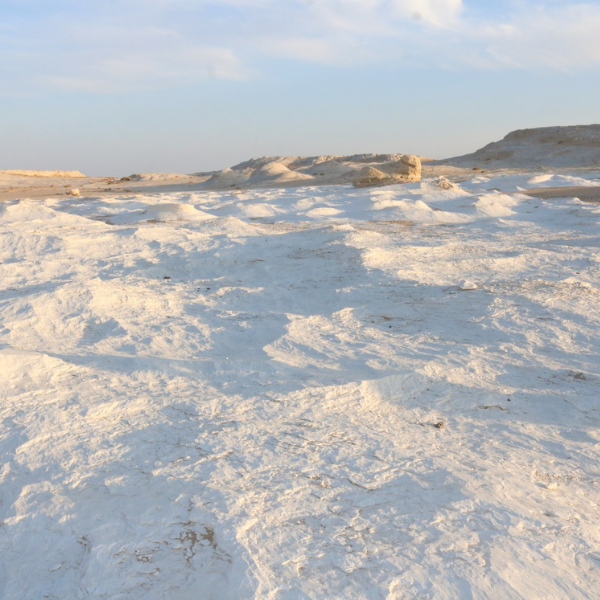
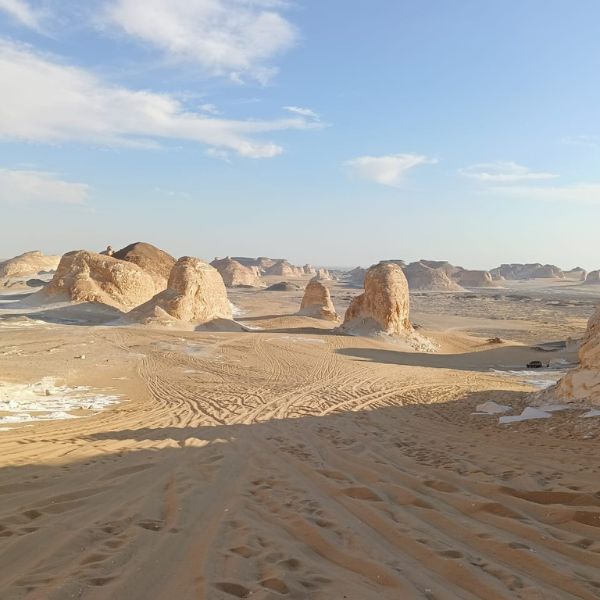
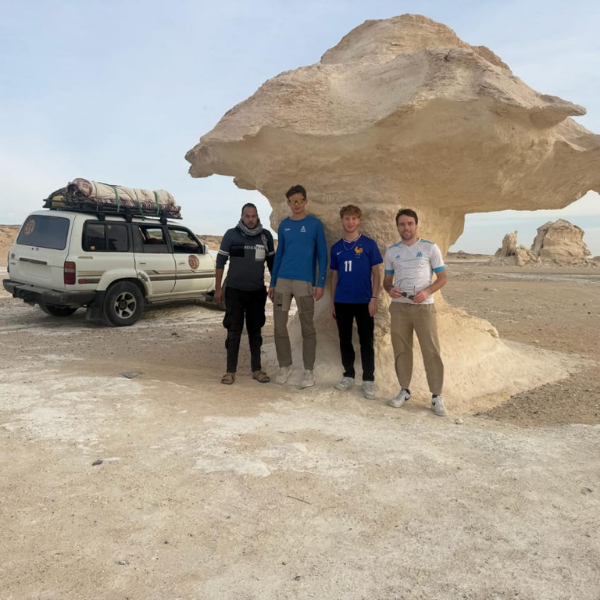
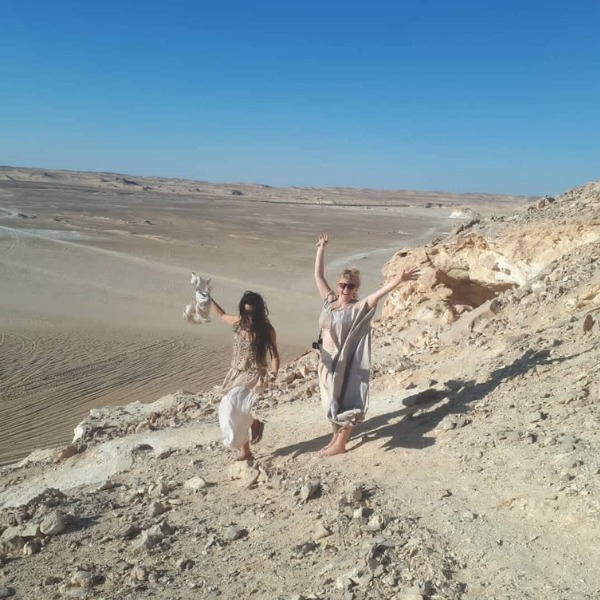
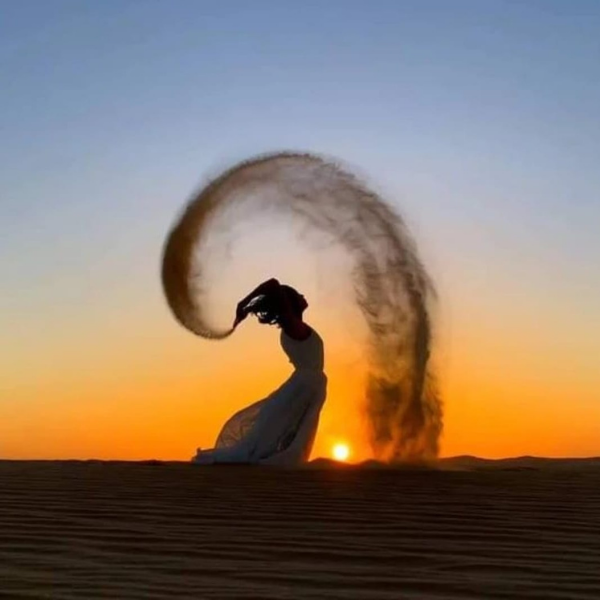
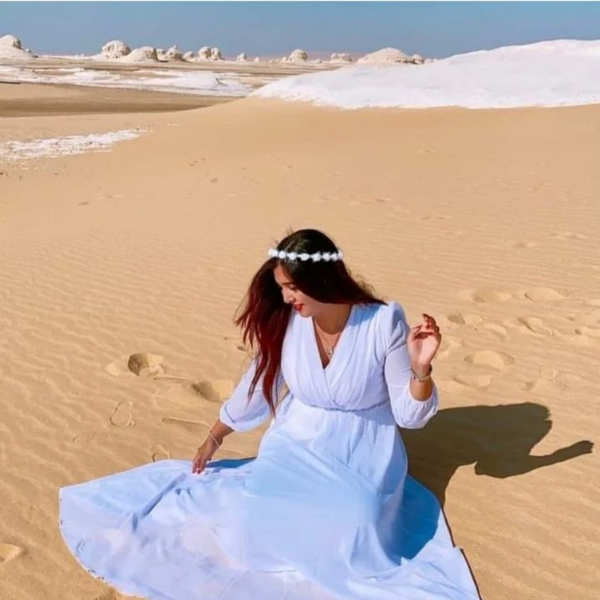
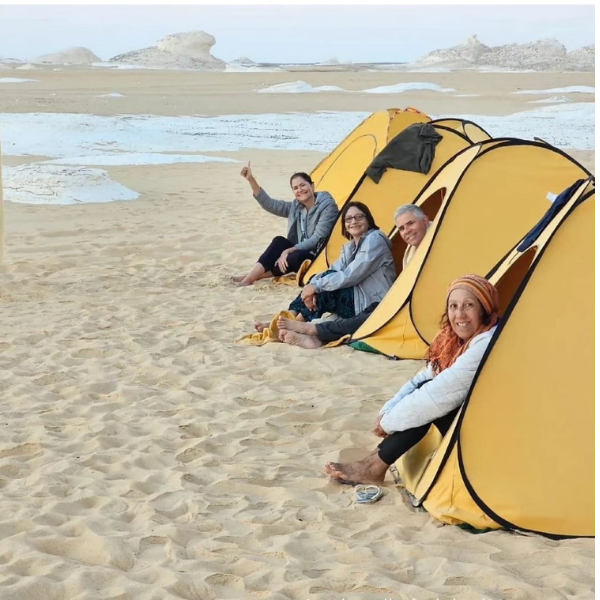
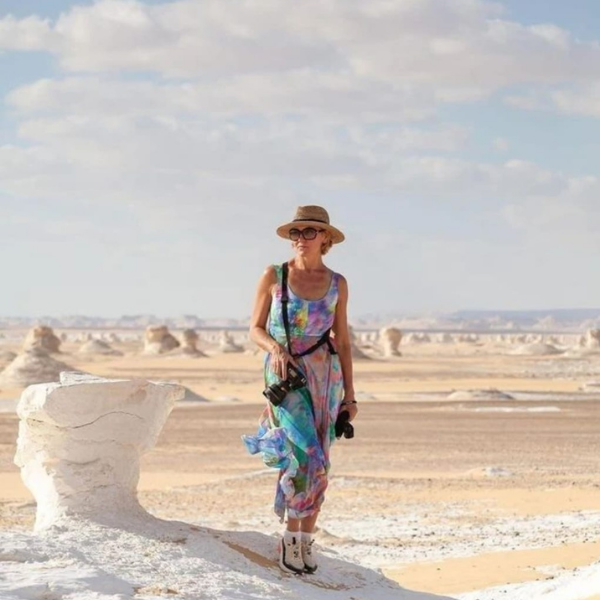
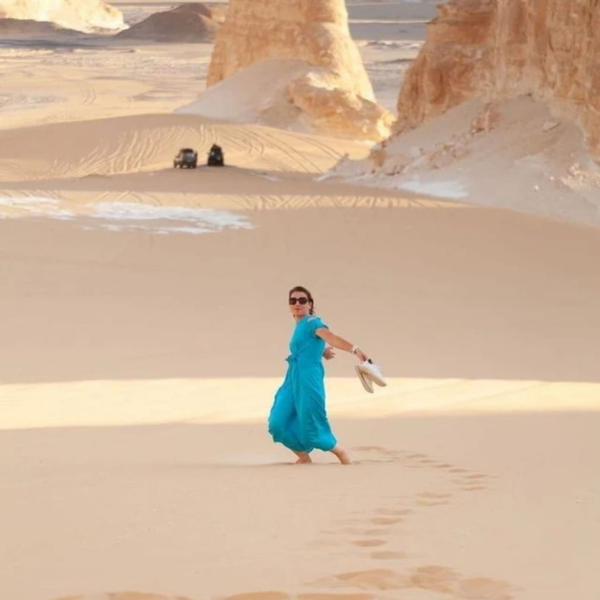
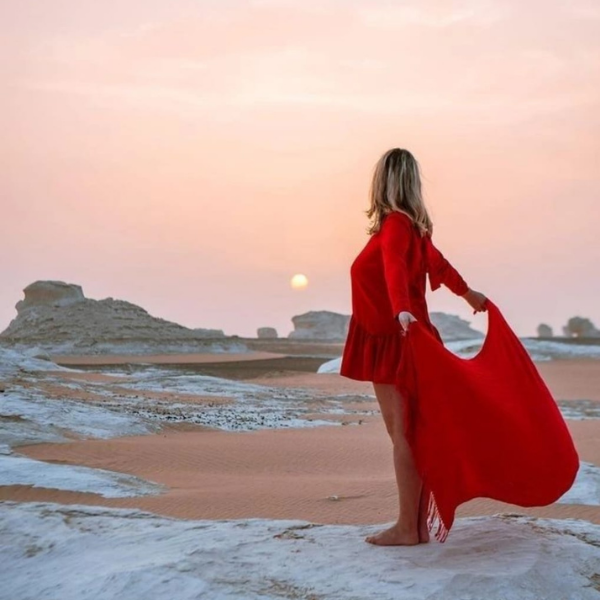
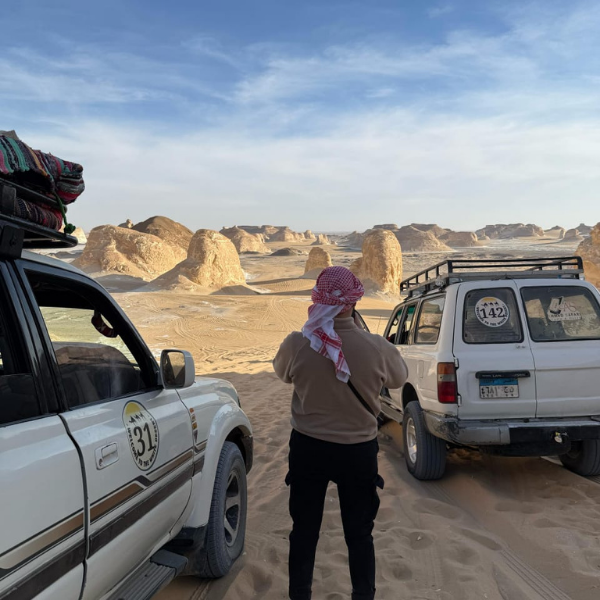
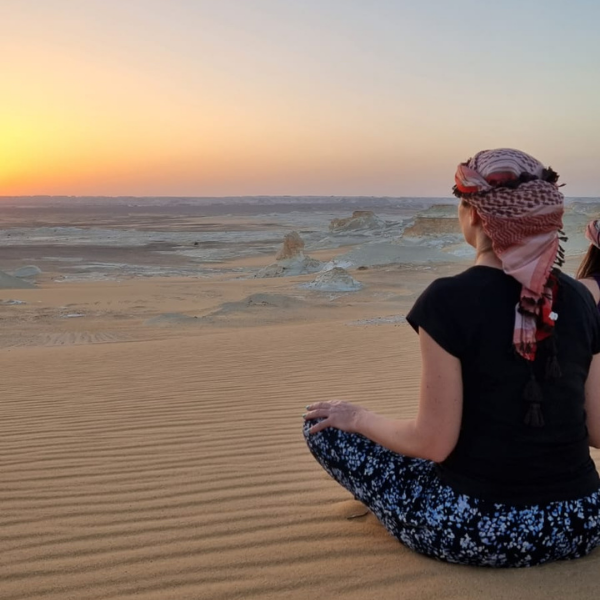
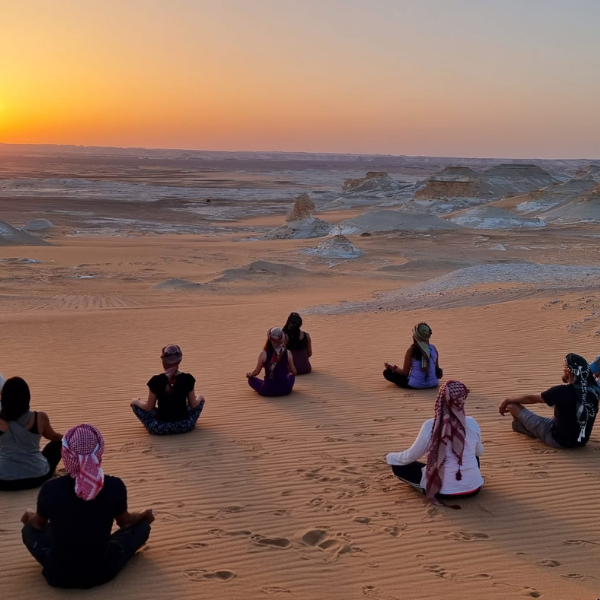
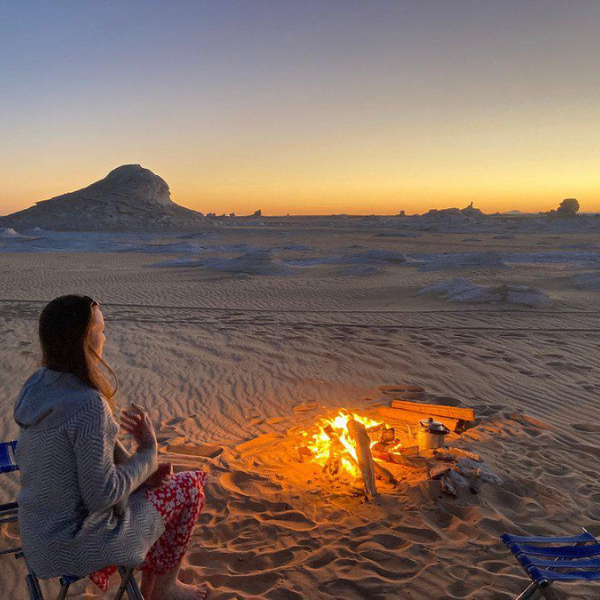
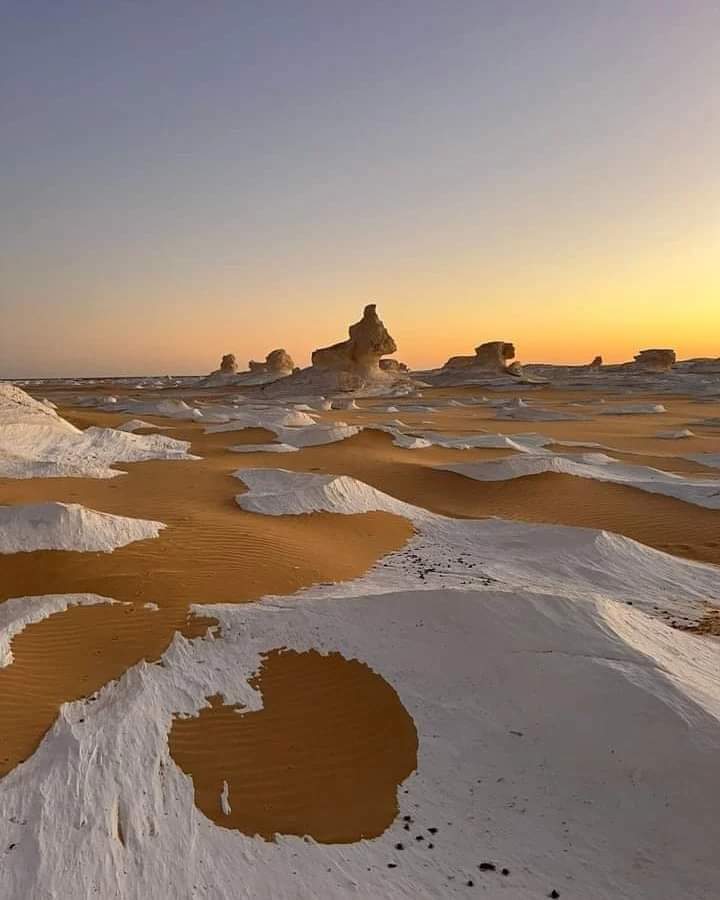
Egypt’s White Desert is impressive at almost any time of day.
At midday, the chalk can look almost snow-white beneath the intense desert sun.
But sunrise and sunset are different.
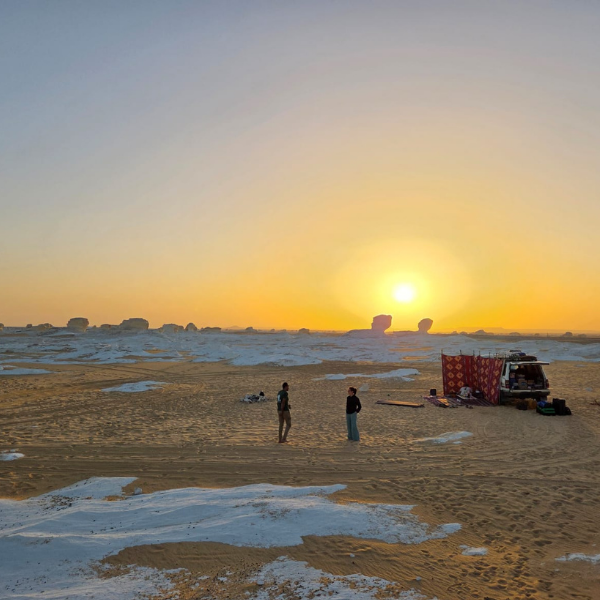
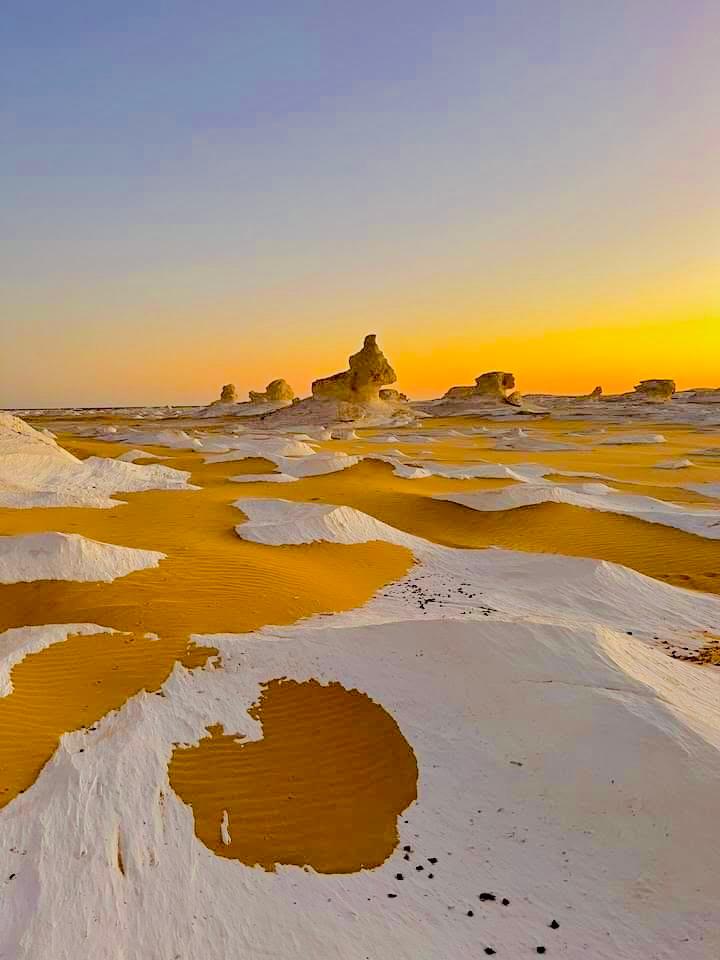
When the Sun moves close to the horizon, the White Desert stops looking simply white.
The rocks begin to turn cream.
Then gold.
Long shadows reveal textures that were almost invisible a few hours earlier.
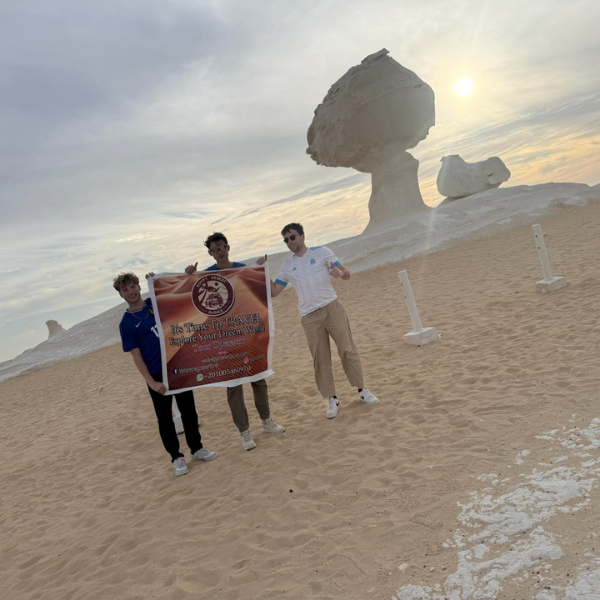
Mushroom-shaped formations become silhouettes.
Golden sand contrasts with cold blue shadows.
And within minutes, the entire landscape can look completely different.
For photographers, this is often the most rewarding period of a White Desert trip.
For everyone else, it’s one of the main reasons an overnight White Desert safari is worth considering instead of rushing through the landscape during daylight and returning immediately.
Egypt’s official tourism authority describes the White Desert as one of the major landscapes around Farafra, famous for its mushroom-shaped white rocks, and notes that trips can range from one night to much longer expeditions involving camping, hiking and 4×4 travel.
That flexibility matters.
Because if you camp inside the wider White Desert landscape, you don’t have to choose between sunset and sunrise.
You can experience both.
For an overview of the destination first, explore the White Desert Egypt Guide.
If you specifically want sunset, camping and sunrise in one trip, see the Tour con pernottamento nel Deserto Bianco da Il Cairo.
White Desert Sunrise & Sunset at a Glance
Question | Quick Answer |
Which is better: sunrise or sunset? | Both are excellent but produce different light |
Best for warm golden color? | Sunset and the first/last minutes of direct sunlight |
Best for quiet conditions? | Sunrise |
Best for silhouettes? | Both |
Best for photography? | Late afternoon through sunset and pre-sunrise through early morning |
Do you need to camp? | Camping is the easiest way to experience both |
Best foregrounds | Mushroom formations, isolated chalk towers, sand ripples and silhouettes |
How early for sunrise? | Be ready 30–45 minutes before sunrise |
How early for sunset? | Ideally be positioned 60–90 minutes beforehand |
Does sunset time stay the same? | No, it changes throughout the year |
Best trip length | At least 2 days / 1 night |
Why Sunrise and Sunset Look So Different in the White Desert
The White Desert’s appearance depends heavily on the angle of sunlight.
At midday, the Sun sits relatively high.
Light strikes the landscape more directly.
Shadows become shorter.
The brilliant pale chalk dominates the scene.
This can be fantastic for showing just how white the formations are, but it isn’t always the easiest light for revealing texture.
Lower-angle light works differently.
When the Sun approaches the horizon, its rays pass across the landscape rather than falling almost directly from above.
That creates longer shadows.
Small ridges become visible.
Wind-carved surfaces gain depth.
Sand ripples suddenly matter.
A rock that seemed relatively flat at noon can appear three-dimensional at sunset.
This effect is particularly powerful in the White Desert because its famous landforms are highly sculptural.
Egypt’s protected-area management material describes abundant chalk stacks in the Farafra region and notes their pitted and sometimes polished surfaces associated with wind action.
Low-angle sunlight helps reveal exactly those details.
Is White Desert Sunrise or Sunset Better?
There’s no universal winner.
They create different experiences.
White Desert Sunset
Usually feels more dramatic.
You’ve already been traveling for hours.
You’ve passed through the desert.
The Sun begins dropping.
White formations turn warmer.
The sky develops color.
Then the landscape slowly becomes dark.
Sunset naturally leads into:
dinner,
camping,
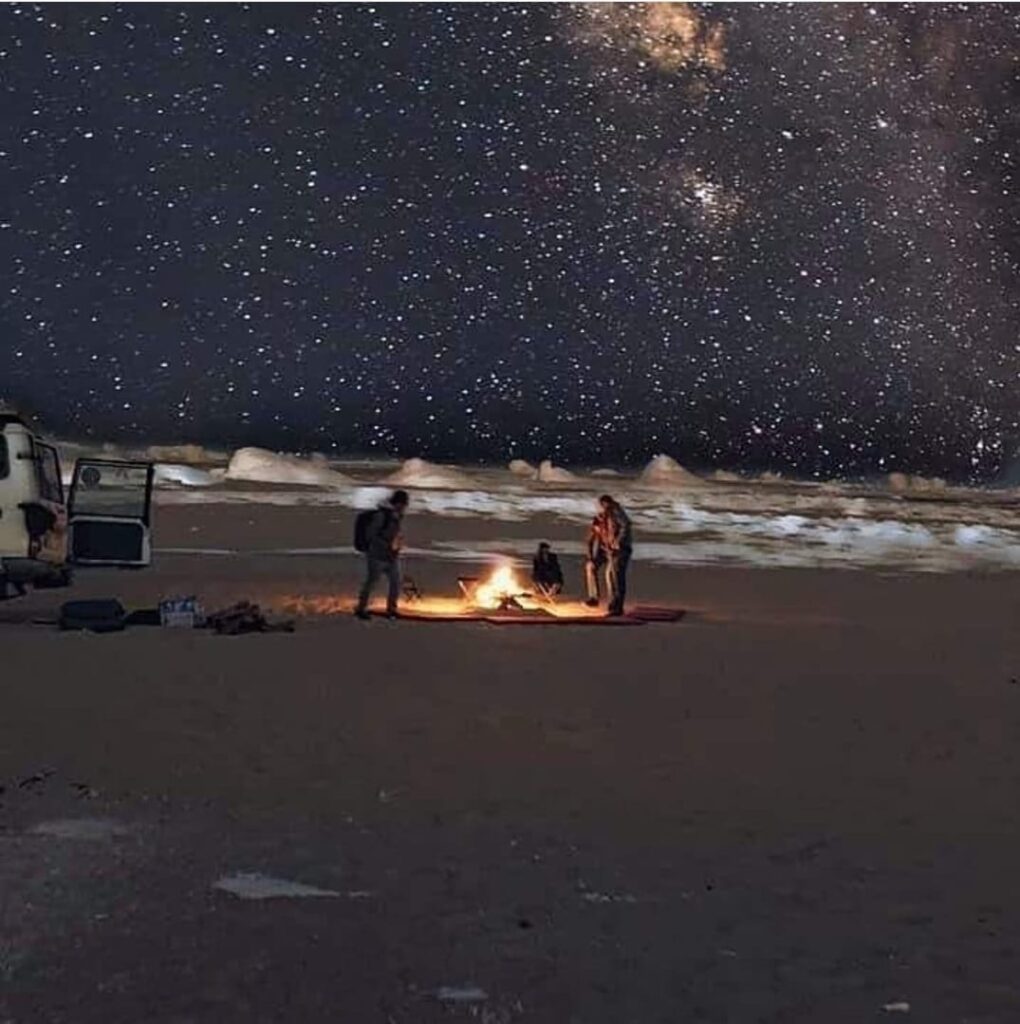
stargazing,
and the desert night.
It’s the emotional climax of Day 1.
White Desert Sunrise
Usually feels quieter.
Most of the world hasn’t started moving yet.
Camp is still calm.
The air may feel cooler.
The formations begin as dark or blue-grey silhouettes.
Then the first warm light touches them.
Instead of watching the desert disappear into darkness, you watch it return.
That’s a very different experience.
My Recommendation: Don't Choose
If you’re already traveling all the way from Cairo to the White Desert, structure the itinerary so you can see:
sunset + stars + sunrise.
That’s one of the strongest arguments for staying overnight.
You don’t need to decide whether sunrise beats sunset.
You can judge for yourself.
What Does White Desert Sunset Look Like?
The transformation starts before the Sun actually reaches the horizon.
An hour or more before sunset, the light begins becoming less harsh.
The white chalk loses some of its brilliant midday glare.
Warm tones appear.
Shadows stretch farther across the ground.
As sunset approaches, formations facing the Sun can shift from:
white
to
cream
to
pale gold.
Meanwhile, shaded sides may remain cool grey or blue.
That contrast creates depth.
The sky can move through:
blue,
yellow,
orange,
pink,
and sometimes red,
depending on atmospheric conditions.
Eventually the Sun disappears.
But don’t put your camera away.
Some of the most interesting color can happen after sunset.
Don't Leave When the Sun Touches the Horizon
A classic photography mistake is assuming:
Sunset = the exact moment the solar disk disappears.
Not quite.
The period afterward can be spectacular.
This is twilight.
The direct sunlight is gone, but the atmosphere remains illuminated.
The sky can become softer.
Warm color may remain near the western horizon.
Meanwhile, the White Desert formations begin reflecting cooler ambient light.
The combination can create:
pink sky,
blue-white chalk,
soft shadows,
and beautifully balanced contrast.
For example, astronomical data for Farafra on October 12, 2026 shows sunset around 6:42 PM, with civil twilight continuing until roughly 7:06 PM. Exact times change throughout the year, but this illustrates why photographers shouldn’t treat the published sunset time as the end of shooting.
Stay ready.
What Does White Desert Sunrise Look Like?
Sunrise begins before the Sun appears.
This is one of the secrets.
If sunrise is listed at 7:00 AM and you wake up at 6:58?
You’re late.
Before sunrise, the eastern horizon begins to brighten.
The sky transitions from black to deep blue.
Then softer blue.
Warm color gradually appears close to the horizon.
At this stage, the chalk formations may still sit in cool shadow.
That can produce beautiful images with:
blue sky,
pink horizon,
and pale rock.
Then direct sunlight arrives.
The first formation catches gold.
Another remains blue.
Within minutes, the entire landscape changes.
That’s the photograph many people miss because they’re still making coffee.
When Should You Wake Up for White Desert Sunrise?
For serious photography:
Be ready about 30–45 minutes before sunrise.
That means:
out of bed,
camera ready,
tripod ready,
warm layer on,
location selected.
Not:
beginning to look for your shoes.
In Farafra, sunrise and twilight times change seasonally. On October 12, 2026, for example, civil dawn begins around 6:42 AM, while sunrise itself occurs around 7:06 AM.
That’s roughly 24 minutes of civil twilight before the Sun appears.
Earlier phases of twilight begin even sooner.
Photographers who arrive before sunrise therefore get an entire sequence rather than one moment.
When Should You Prepare for Sunset?
Sunset planning should begin even earlier.
I recommend being in the wider sunset area around:
60–90 minutes before actual sunset.
Why so early?
Because the White Desert contains too many compositions.
You don’t want to spend the best light driving around saying:
“Maybe the next formation is better.”
Scout first.
Choose your foreground.
Check where the Sun will set.
Then stay long enough for the light to develop.
Why You Shouldn't Chase the Sun at the Last Minute
Desert distances can be deceptive.
A formation that looks five minutes away may take much longer to reach due to:
sand,
tracks,
protected areas,
vehicle restrictions,
and terrain.
If you’re still moving between viewpoints when golden light begins, you may spend the best 20 minutes inside a 4×4.
A better strategy is:
see more places during midday,
then deliberately slow down before sunset.
The goal changes.
Before sunset:
stop collecting attractions.
Start experiencing the light.
Best White Desert Sunset Locations
There’s no single official “Sunset Point” that always beats everything else.
The White Desert is a broad landscape containing numerous formations.
Your ideal viewpoint depends on:
season,
Sun direction,
current route,
approved access,
camping location,
and what kind of photograph you want.
Still, several landscape types work especially well.
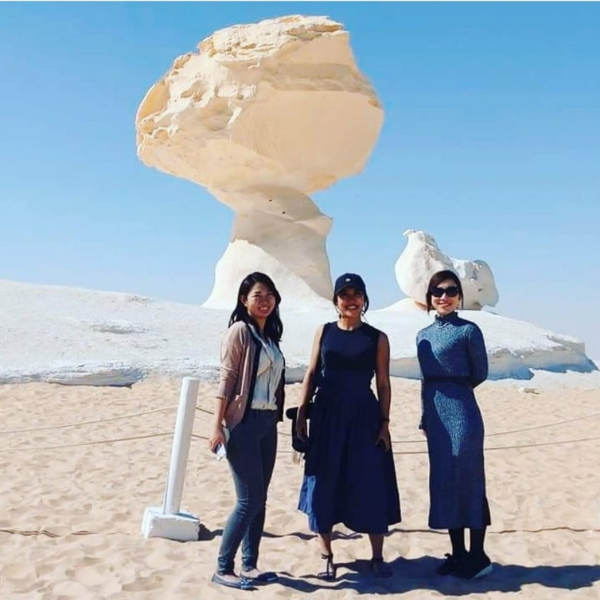
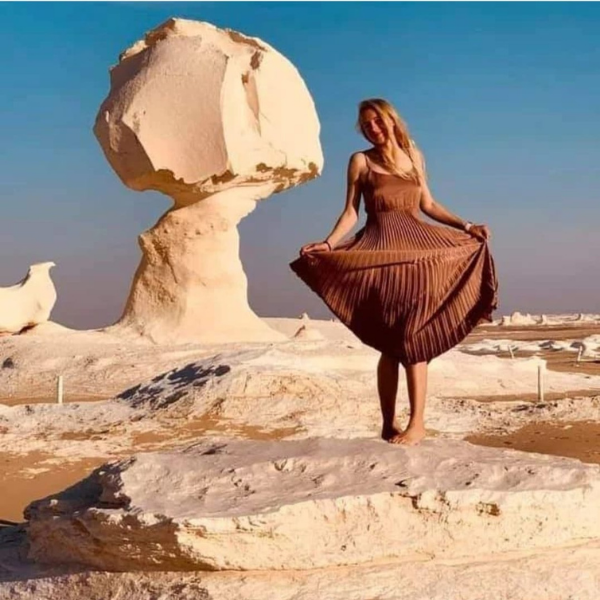
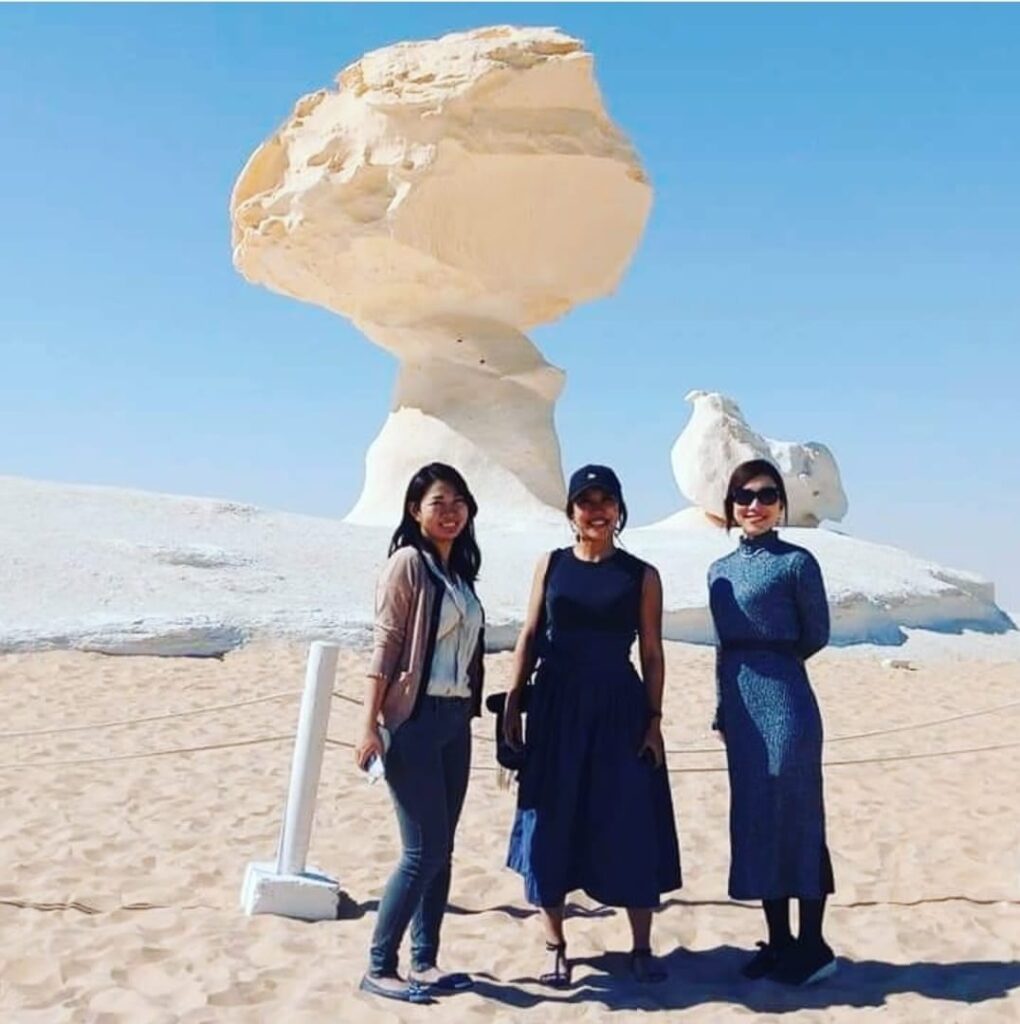
1. Isolated Mushroom-Shaped Formations
These are classic.
Why?
Because their narrow bases and broad tops create recognizable silhouettes.
Place the setting Sun:
beside the formation,
behind it,
or partially obscured by it,
and the shape becomes immediately readable.
For more on these formations, see the Mushroom Rock White Desert Egypt Guide.
2. Open New White Desert Landscapes
More open sections can be excellent for sunset because they allow:
clean horizon lines,
isolated formations,
negative space,
and broad sky.
You’re not forced to photograph only one famous rock.
Sometimes a distant line of small formations against a huge orange sky produces a stronger photograph.
3. Areas with Golden Sand and White Chalk Together
This combination is fantastic.
Late sunlight warms the sand.
White chalk stays relatively pale.
Cool shadows begin appearing.
You get three contrasting elements:
gold,
white,
blue-grey.
This works beautifully for both photography and simple sightseeing.
4. Higher or Open Panoramic Areas
A slightly elevated view allows you to see the shadows stretching across larger sections of terrain.
This can reveal the scale of the landscape far better than photographing only individual rocks.
However, access and safety come first.
Don’t climb fragile chalk just to gain height.
Is Agabat Valley Better for Sunset Than the White Desert?
Agabat can be incredible in low light.
Its cliffs and broad landscapes can produce dramatic late-afternoon photography.
But if you’re doing the standard overnight route, there is a strong argument for continuing into the White Desert for sunset because then you naturally transition into:
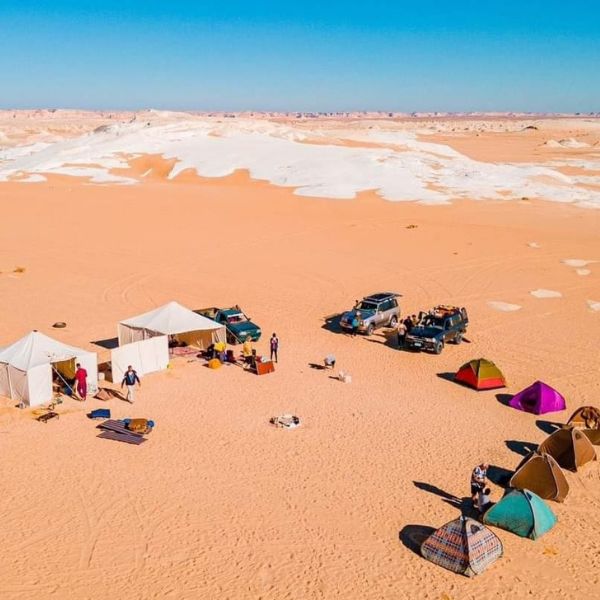
camping,
stars,
and sunrise.
Egypt’s official tourism portal describes Agabat as famous for soft golden sand, dunes and distinctive white cliffs.
For the full stop, see the Agabat Valley Egypt Guide.
My preference for a first trip:
enjoy Agabat during afternoon,
then save sunset for the White Desert.
Best White Desert Sunrise Locations
Sunrise works differently because the camp location matters.
Unlike sunset, you generally don’t want to begin the morning with a long drive before first light.
The best sunrise location is often:
an attractive formation or open landscape within practical walking distance of your approved camp.
That lets you:
wake early,
walk quietly,
set up,
and photograph dawn
without starting vehicles before everyone else wakes.
A good operator can consider sunrise when selecting an overnight area, subject to current protected-area and permit rules.
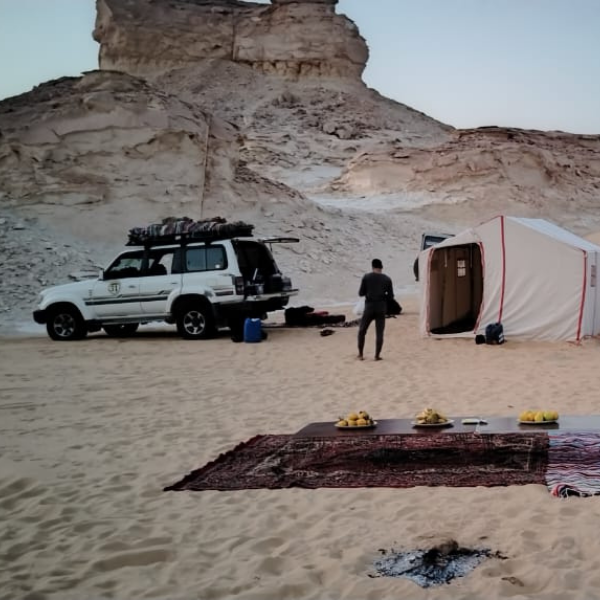
Can You Watch Sunrise from Your Camp?
Often, yes.
And honestly, that’s one of the best parts of camping.
You don’t necessarily need an official viewpoint.
Open the tent.
Step outside.
Look east.
The desert is already there.
This is the luxury of location.
In a hotel, you’d need to:
wake up,
dress,
meet a driver,
travel,
and hope you arrive in time.
In a desert camp?
You’re already inside the photograph.
Sunrise vs Sunset for Photography
Here’s the practical comparison.
Feature | Sunrise | Sunset |
Warm light | Excellent | Excellent |
Crowds/activity | Usually lower | Potentially higher |
Cool blue tones | Strong before sunrise | Strong after sunset |
Silhouettes | Excellent | Excellent |
Energy level | Requires early wake-up | Easier for most travelers |
Camp integration | Excellent | Excellent |
Dust from vehicles | Often lower early | Can be higher after travel day |
Best mood | Quiet, peaceful | Dramatic, cinematic |
For photographers:
shoot both.
They tell different stories.
Best Lens for White Desert Sunrise & Sunset
You don’t need a massive camera bag.
Wide-Angle Lens
Great for:
large skies,
rock + landscape,
dramatic foregrounds,
and sunrise panoramas.
Something around 16–35 mm full-frame equivalent is versatile.
Standard Zoom
A 24–70 mm equivalent can handle almost everything.
It’s probably the easiest single lens for travel photographers.
Telephoto
Don’t ignore it.
A 70–200 mm-style lens can:
compress distant formations,
make the Sun appear larger relative to rocks,
and isolate layers of landscape.
Some of the strongest desert images come from telephoto lenses rather than ultra-wide shots.
Can You Photograph the Sun Directly?
Be careful.
Photographing a normal sunrise or sunset is not the same as photographing a solar eclipse through a long telephoto lens, but concentrated sunlight through optical equipment can still be hazardous to eyes.
Never look directly at the Sun through an optical viewfinder or telescope.
Use safe photographic practices and live view where appropriate.
The easier approach for most travelers is not to make the Sun itself the entire subject.
Use it as part of the landscape.
Best Camera Settings for White Desert Sunset
There’s no single correct setting.
But for landscape photography, a useful starting philosophy is:
ISO
Keep it relatively low while enough light remains.
Aperture
Use something like f/8–f/11 when you want broad depth of field.
Shutter Speed
Let it change as the light drops.
RAW
Shoot RAW if you plan to edit.
The challenge is dynamic range.
The sky near the Sun may be extremely bright while the shaded side of the rock becomes dark.
Expose carefully to avoid destroying highlight detail.
Should You Use HDR?
Sometimes.
High-contrast sunset scenes can exceed what a single exposure handles comfortably.
Bracketing several exposures allows you to preserve:
bright sky
and
dark foreground.
But don’t feel obligated to turn every White Desert photograph into extreme HDR.
The desert’s natural shadows are part of the scene.
A little darkness creates depth.
Sunrise Camera Settings
Sunrise generally begins darker than sunset ends.
Before the Sun appears:
use a tripod.
Shutter speeds may be slow.
Keep ISO under control if the scene is static.
Once direct sunlight arrives, exposures become much easier.
The real challenge is reacting quickly.
Light can change substantially every few minutes.
Use the White Rocks as Natural Reflectors
One interesting advantage of White Desert photography is obvious once you’re there:
the rocks are bright.
That means they reflect a lot of ambient light.
Even after the Sun drops low, a formation can retain more visible detail than a very dark sandstone rock might.
This helps during:
twilight,
moonlight,
and some night photography.
It’s another reason the White Desert transitions so beautifully from day into night.
Use People for Scale
The White Desert has almost no conventional scale references.
No apartment buildings.
No streetlights.
Few trees.
That means a large formation can look surprisingly small in a photograph.
Put a person near it.
Suddenly the viewer understands.
Sunrise and sunset silhouettes are particularly effective.
One traveler standing beside a massive chalk formation can tell the story immediately.
Don't Put the Sun in Every Photo
This is surprisingly important.
Sunset photography doesn’t require the Sun to appear in the frame.
Turn around.
Sometimes the best light is behind you.
The setting Sun may illuminate a formation in warm gold while the eastern sky turns:
pink,
purple,
or soft blue.
That’s often more interesting than photographing yet another orange ball on the horizon.
At sunrise, do the same.
Look west.
See what the first light is touching.
Use Side Lighting
Side lighting is one of the White Desert’s greatest photographic advantages.
When sunlight strikes a formation from the side, one half can glow while the other remains shadowed.
That reveals:
curves,
erosion,
holes,
layers,
and surface texture.
Compare that with midday light from almost overhead.
The difference is dramatic.
Look for Sand Ripples
Everyone photographs the big chalk rocks.
Look downward too.
Wind creates repeating patterns in the sand.
Use those lines as foreground elements pointing toward:
a mushroom rock,
sunset,
or distant formation.
At low Sun angles, tiny sand ridges cast shadows.
That makes texture much more visible than at noon.
Create a Sunstar
If your camera and lens allow it, try partially hiding the Sun behind a formation and stopping the aperture down.
You may create a starburst effect as the Sun peeks around the edge.
This is particularly effective with:
mushroom formations,
arches,
and irregular rock edges.
Experiment.
But don’t sacrifice eye safety by staring through an optical viewfinder at the Sun.
Silhouettes Can Be Better Than Detail
When sunset becomes intense, stop fighting the contrast.
Use it.
Expose for the bright sky.
Let the formation become black.
A recognizable mushroom silhouette against:
orange,
pink,
or purple
can be more powerful than a perfectly detailed rock.
The same works before sunrise.
Does Cloud Ruin White Desert Sunset?
Not necessarily.
Cloud can actually make sunset more interesting.
A perfectly clear desert sky often produces:
clean gradient,
strong color,
predictable light.
Thin or broken clouds can catch sunlight and create more dramatic color.
The problem comes when dense cloud completely blocks the low Sun.
Even then, blue-hour photography can still work.
So don’t abandon the camera because the sky isn’t perfectly clear.
What Is Blue Hour in the White Desert?
Blue hour is the period of cool, low natural light before sunrise or after sunset.
The exact duration varies.
The sky turns deep blue.
Warm direct sunlight disappears.
The white chalk can become:
grey,
silver,
or blue.
This can create a completely different visual style from golden hour.
Blue hour is especially beautiful with:
camp tents,
small warm lights,
formations,
and open sky.
It’s also the natural bridge toward the stargazing experience.
For night planning, see the White Desert Stargazing Guide.
Does Moon Phase Matter for Sunrise and Sunset?
Less than it matters for stargazing.
But it can add something special.
Imagine:
Sun setting in the west
while
a bright Moon rises elsewhere.
Or a crescent Moon hanging above chalk formations during twilight.
Moon position can become an additional photographic element.
For serious landscape photographers, astronomy-planning apps can help determine:
Moonrise,
Moonset,
Moon phase,
and direction.
For ordinary travelers?
Don’t overcomplicate it.
The White Desert already gives you enough to look at.
Does the Season Change Sunrise and Sunset Direction?
Yes.
The Sun does not rise from exactly the same point or set at exactly the same point every day of the year.
Its position shifts with the seasons.
Farafra solar data illustrates this clearly. During October 2026, for example, sunrise direction progressively shifts south of due east while sunset shifts south of due west as the month advances.
This matters for photographers because a composition that works perfectly in October might place the Sun differently in January.
If one exact formation matters to you:
check the Sun direction for your date.
Does the Season Change Sunrise and Sunset Time?
Absolutely.
Egypt’s official tourism information notes that average daylight across the country ranges roughly between 10 and 14 hours, depending on the season.
That means your safari schedule must change throughout the year.
You should never copy a sunset time from an old January itinerary and assume it works in April.
Use the date of your actual trip.
Example: Farafra Sunset in October
To illustrate the change even within one month:
Farafra’s published October 2026 data shows sunset moving from about:
6:54 PM on October 1
to
6:29 PM on October 26.
That’s a 25-minute shift in less than one month.
For tour planning, that’s significant.
It can be the difference between:
arriving before golden hour
and
arriving after sunset.
Why Good Tour Timing Matters
A White Desert itinerary can look perfect on paper:
Black Desert.
Crystal Mountain.
Agabat.
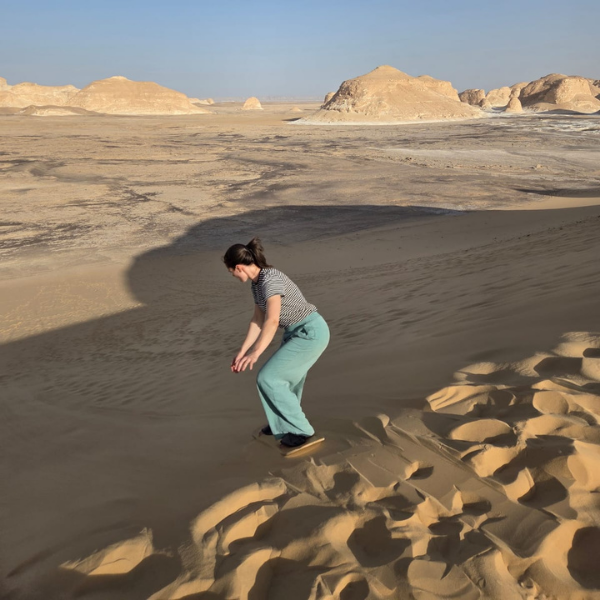
Lunch.
Sandboarding.
White Desert.
Camp.
But if every earlier stop runs 20 minutes late, sunset pays the price.
This is why experienced desert guiding matters.
The operator needs to balance:
sightseeing
with
light.
On some days, spending five additional minutes at one afternoon stop is fine.
On others, those five minutes should be saved for sunset.
What Time Should You Leave Bahariya?
There’s no single answer because:
season,
road conditions,
route,
permits,
tour format,
and sunset time
all vary.
But your itinerary should be built backwards from the day’s sunset.
If sunset is a priority, the question isn’t:
“How many places can we squeeze in?”
It’s:
“What time must we reach the White Desert with enough margin to enjoy the light?”
That’s a much better way to plan.
Why a Private Safari Can Help Photographers
Shared tours work perfectly well for many visitors.
But photographers often move differently.
One person wants 30 seconds at a formation.
A photographer might want 30 minutes.
A private tour can sometimes provide more flexibility around:
sunset,
sunrise,
tripod setup,
specific foregrounds,
and waiting for changing light.
If serious photography is a major goal, consider the Private White Desert Safari from Cairo Guide.
Is 2 Days Enough for Sunrise and Sunset?
Yes.
A classic 2-day / 1-night White Desert safari can provide:
Day 1 sunset,
night camping,
stargazing,
Day 2 sunrise.
That’s one reason the format is so popular.
It gives you three of the landscape’s best lighting conditions inside one relatively short trip.
See the Tour con pernottamento nel Deserto Bianco da Il Cairo.
Is 3 Days Better for Photography?
Definitely.
A 3-day / 2-night itinerary gives you:
two sunsets,
two sunrises,
two night skies,
and much more flexibility.
If one evening is dusty?
You have another.
If one sunrise has flat light?
You have another.
If you find an incredible formation but arrive at midday?
You might be able to revisit or photograph a similar landscape later.
Explore the Tour di 3 giorni nel Deserto Bianco da Il Cairo.
You can also compare durations in the 2-Day vs 3-Day White Desert Tour Guide.
Is Camping Necessary for Sunrise?
Practically, it’s the best option.
Without camping, you’d need to travel into the desert before sunrise.
That adds:
driving,
timing risk,
navigation,
and unnecessary complexity.
Camping means your sunrise commute may be:
two minutes on foot.
That’s hard to beat.
What Should You Wear at Sunrise?
More than you wore during the afternoon.
Desert temperatures drop after dark.
And standing still before sunrise often feels colder than expected.
Bring:
long trousers,
closed shoes,
warm layer,
jacket when appropriate,
and perhaps a hat during colder periods.
Photographers especially may stand in one place for a long time.
For the complete packing list, see the What to Pack for White Desert Egypt Guide.
Protect Your Camera from Sand
Sunset often comes after a full day of desert travel.
Dust and sand may already be on your equipment.
Before golden hour:
clean the front element carefully.
Check the sensor if you’ve changed lenses.
Prepare batteries.
Prepare memory cards.
You don’t want to discover a dirty lens after the Sun has gone.
During windy conditions, avoid changing lenses unnecessarily.
Charge Everything Before Night
Your camera might survive sunset.
Then you use it for:
camp,
stars,
Milky Way,
and sunrise.
Suddenly the battery that looked fine at 5 PM is empty at 6 AM.
Bring spares.
Charge devices before leaving the oasis.
Carry power banks where useful.
An overnight White Desert trip creates more photography opportunities than a normal day tour, which also means more power consumption.
Sunset into Stargazing: The Perfect Sequence
The White Desert’s strongest feature isn’t one individual moment.
It’s the sequence.
Afternoon
Bright chalk.
Golden Hour
Warm formations.
Sunset
Silhouettes.
Twilight
Cool blue landscape.
Night
Stars.
Dawn
Pastel sky.
Sunrise
Warm light returns.
That’s why an overnight safari feels so much richer than visiting for only a few daylight hours.
You’re watching one landscape transform repeatedly.
Sunrise into Breakfast
Sunrise is also more enjoyable when nobody immediately says:
“Get in the car.”
Take a few minutes.
Photograph.
Walk.
Drink tea.
Watch how quickly the light changes.
Then eat breakfast.
The landscape becomes brighter.
The photographic drama decreases.
And that’s the perfect time to continue the safari.
Good itinerary design uses the strong light for photography and the harsher daylight for travel and sightseeing.
Best Sunrise and Sunset Experience for Non-Photographers
You don’t need a camera to care about any of this.
In fact, sometimes the photographer spends so much time adjusting a tripod that everyone else notices more.
For non-photographers:
put your phone down occasionally.
Watch how the shadows move.
Notice how fast the rock color changes.
Look behind you.
Listen to the silence.
The White Desert sunset lasts far longer in your memory than the 47 nearly identical photos sitting in your camera roll.
Are White Desert Sunrise and Sunset Good for Couples?
Very.
The landscape is already quiet and remote.
Sunset adds intimacy.
Afterward comes:
dinner,
stars,
camping.
Then sunrise the following morning.
For couples wanting something completely different from a normal hotel stay, that sequence is difficult to replicate elsewhere in an Egypt itinerary.
Are They Good for Families?
Absolutely.
Kids often enjoy the shapes of the rocks during daylight.
Sunset adds color.
Camping makes the trip feel like an adventure.
The only challenge with sunrise is obvious:
you have to wake everyone up.
If the children are exhausted?
Don’t turn sunrise into military training.
Enjoy camp.
The desert will forgive you.
Sunrise or Sunset for Solo Travelers?
Both.
Solo travelers often have an advantage:
you can focus entirely on the environment.
A shared tour also gives you people to photograph for scale.
A private itinerary gives more control over timing.
If you’re traveling alone but photography matters, tell the operator before the trip.
That helps set expectations.
Can You Fly a Drone at Sunrise or Sunset?
Do not assume drone use is permitted.
Drone ownership, importation and operation in Egypt can be subject to strict rules and approvals, while protected-area restrictions may create additional constraints.
Never bring or operate a drone based solely on the assumption that:
“it’s empty desert, so nobody will care.”
Check current Egyptian requirements and operator guidance before travel.
A camera and tripod are much simpler.
Responsible Sunrise and Sunset Photography
The perfect composition is not worth damaging the landscape.
Don’t:
climb fragile chalk formations,
break pieces,
move fossils,
carve names,
drive off approved tracks,
or position vehicles beside vulnerable rocks just for scale.
The White Desert is a protected natural landscape.
Egypt’s official environmental material describes the area as geologically important and notes extensive wind-sculpted chalk stacks across the Farafra region.
Those formations have survived natural erosion for extraordinary periods.
They shouldn’t lose pieces because somebody wanted a better Instagram angle.
Do You Need a Guide?
Remote White Desert travel should be properly organized.
Egypt’s official tourism portal recommends checking permits and current regulations with an authorized guide or travel agency before entering desert excursion areas. It also identifies 4×4 exploration and camping as common ways to experience the White Desert.
Official tourism guidance for Bahariya likewise recommends experienced licensed guides for excursions outside the oasis.
This matters especially at sunrise and sunset.
You don’t want to become lost or stranded because you independently chased a pretty viewpoint after dark.
A Perfect White Desert Sunrise & Sunset Itinerary
Here’s a strong 2-day structure.
Day 1 — Cairo to Bahariya
Leave Cairo early.
Travel into the Western Desert.
Reach Bahariya.
Lunch and safari preparation.
Deserto Nero
Explore the dark hills and wider landscape.
Read the Black Desert Egypt Guide.
Montagna di Cristallo
See the mineral-rich geological landmark.
Explore the Crystal Mountain Egypt Guide.
Agabat Valley
Explore golden dunes and enormous pale cliffs.
Allow enough time to enjoy the landscape without sacrificing sunset.
Late Afternoon — Enter the White Desert
The pace slows.
Begin watching the light.
Choose formations for photography.
Golden Hour
Walk.
Photograph.
Enjoy the changing chalk colors.
Sunset
Stop moving.
Watch.
Twilight
Stay outside after the Sun disappears.
Photograph blue hour.
Let the desert become dark.
Camp
Dinner.
Tea.
Stars
Switch off unnecessary lights.
Read our White Desert Stargazing Guide if the night sky is a priority.
Day 2 — Pre-Sunrise
Wake early.
Dress warmly.
Walk to the selected viewpoint.
Dawn
Photograph or simply watch the changing sky.
Sunrise
Wait for direct sunlight to hit the formations.
Don’t leave immediately.
Breakfast
Return to camp.
Eat.
Pack.
Morning Exploration
Continue through additional White Desert formations while light remains pleasant.
Then return toward Bahariya and Cairo.
Simple.
And far better than trying to experience the White Desert between noon and 3 PM only.
White Desert Sunrise & Sunset vs Midday
Midday isn’t bad.
It has its strengths.
The landscape looks brilliantly white.
Blue-sky contrast can be dramatic.
Geological details become easy to see.
But sunrise and sunset provide:
longer shadows,
stronger depth,
warmer color,
greater atmosphere,
and more emotional photographs.
So the correct approach isn’t:
avoid midday.
It’s:
use midday differently.
Midday = exploration.
Golden hour = slow down.
Sunset = stop.
Night = look up.
Sunrise = wake up.
That’s the rhythm.
Is White Desert Sunrise Worth Waking Up For?
Yes.
Especially if this may be your only White Desert trip.
You can sleep when you’re back in Cairo.
The best part is that sunrise doesn’t require another five-hour journey.
You’re already there.
All you need to do is get out of bed.
And unlike many famous sunrise destinations, you probably won’t be standing shoulder-to-shoulder with hundreds of tourists waiting for one viewpoint.
The experience is much more about the landscape around your own camp.
Is White Desert Sunset Worth Planning the Itinerary Around?
Also yes.
But don’t interpret that as:
“skip everything else.”
Black Desert, Crystal Mountain and Agabat are all worthwhile.
The trick is itinerary discipline.
Give each stop enough time.
Then protect the final hour before sunset.
For photographers especially, that final hour may produce more memorable images than three hours of midday shooting.
Final Verdict: Sunrise or Sunset?
Best colors:
Sunset
Quietest atmosphere:
Sunrise
Best transition into camping:
Sunset
Best transition from stars into day:
Sunrise
Best for photography:
Both
Best overall experience:
Overnight safari that includes both
The White Desert doesn’t have one perfect hour.
Its real magic is watching the same landscape move through:
white,
gold,
orange,
blue,
black,
and gold again.
The rocks don’t move.
The light does.
And that’s enough to transform everything.
For the full adventure, explore the Safari nel Deserto Bianco dal Cairo.
For one sunset, one night and one sunrise, choose the Tour con pernottamento nel Deserto Bianco da Il Cairo.
For two chances at both sunrise and sunset, explore the Tour di 3 giorni nel Deserto Bianco da Il Cairo.
Or browse all Egypt Desert Dunes tours to compare your options.
Safari nel Deserto Bianco: Il Cairo, Oasi di Bahariya e Avventura in Campeggio
Egypt Desert Dunes Explore the Journey Stop 01 White Desert Swipe photos ‹ › White Desert White Desert White Desert White Desert White Desert…
Tour di una notte nel Deserto Bianco dal Cairo
Egypt Desert Dunes Explore the Journey Stop 01 White Desert Swipe photos ‹ › White Desert White Desert White Desert White Desert White Desert…
Tour di 3 giorni nel Deserto Bianco dal Cairo
Egypt Desert Dunes Explore the Journey Stop 01 White Desert Swipe photos ‹ › White Desert White Desert White Desert White Desert White Desert…
Safari alla Grotta di Djara e nel Deserto Bianco
Egypt Desert Dunes Explore the Journey Stop 01 White Desert Swipe photos ‹ › White Desert White Desert White Desert White Desert White Desert…
Safari a dorso di cammello nel Deserto Bianco
Egypt Desert Dunes Explore the Journey Stop 01 White Desert Swipe photos ‹ › White Desert White Desert White Desert White Desert White Desert…
Tour del Deserto Occidentale dal Cairo
Egypt Desert Dunes Explore the Journey Stop 01 White Desert Swipe photos ‹ › White Desert White Desert White Desert White Desert White Desert…
Book Egypt Desert Dunes Tours on Viator
Discover our private White Desert camping adventures and Siwa Oasis experience. Choose your favorite itinerary and complete your reservation securely through Viator.
4-Day Private Camping Tour in the White Desert from Cairo
Go deeper into Egypt's Western Desert with a private four-day camping adventure including spectacular desert landscapes, Black Desert, White Desert, open-air meals and three nights beneath the stars.
2-Day, 1-Night Camping Tour in White Desert from Cairo
Our most compact White Desert adventure for travelers who want to experience the desert from Cairo, explore its unique landscapes and spend an unforgettable night camping beneath the stars.
3-Day Private Camping Tour of White Desert from Cairo
Spend three days exploring the Western Desert, including the Black Desert, Crystal Mountain, Aqabat area and White Desert, with two nights of private desert camping.
Siwa Oasis Trip with Cairo Pick Up
Travel from Cairo to legendary Siwa Oasis on a private four-day journey exploring Siwan culture, desert landscapes, Lake Siwa, traditional sites and some of the oasis's most distinctive attractions.
Explore Egypt's Desert with Egypt Desert Dunes
From a one-night White Desert camping adventure to extended Western Desert and Siwa Oasis experiences, choose the itinerary that matches your travel style and complete your booking through Viator.
Book a Tour or Create Your Own Egypt Experience
Choose one of our ready-made tours or customize your own private journey. Select your destinations, duration and travel style, then send your request directly to Egypt Desert Dunes on WhatsApp.
Book Your Desert Tour
Select your preferred itinerary and send us your travel details. Our team will reply on WhatsApp with availability and the final quote.
Create Your Own Private Egypt Tour
Combine Cairo, Giza, Fayoum, the Western Desert and Siwa in one custom itinerary. Choose the destinations and experiences you want and our team will recommend the best route based on your available days.
Cosa dicono i nostri ospiti su TripAdvisor
Esperienze reali di viaggiatori che hanno esplorato i deserti, le oasi e le meraviglie culturali dell'Egitto con Egypt Desert Dunes. Leggi le loro recensioni su TripAdvisor e scopri perché i nostri ospiti ci scelgono per safari privati nel deserto, avventure in campeggio e tour indimenticabili in Egitto.
Posted on Tripadvisor InesamaralVerified Magical moments in the White Desert The White Desert tour was one of our favourite moments in Egypt. The sunset and sunrise surrounded by a lunar landscape were absolutely incredible. Mohammed was very responsive, since the beginning and he adapted the tour to all our needs. The food was delicious, we had the opportunity of having some sort of showers during the trip and the pace of the tour was really good too. He kindly helped us sort some further travel plans with a trustworthy agency in Luxor. I can definitely recommend Mohammed, who is Bedouin, and his small team for your adventure in the desert, you just need to relax and enjoy. On a final note, we were two female travellers and always felt safe and comfortable. Thank you for everything!Posted on Tripadvisor CladehVerified Amazing Desert Dunes Adventure 🏜️ Our two-day adventure to the Western Desert with Egypt Desert Dunes was an amazing experience, that I can safely recommend to anyone! Cairo pick-up was directly from hotel, and transport was in a very modern and comfortable car. Enough breaks at (not overpriced!) gas stations. Lunch at Bahariya was in a guesthouse-like space that we shared with a few other small groups. I personally wished for a more private and "local" lunch experience, but that's minor detail. Food was tasty and they asked if we wanted more! Eventually we changed to a jeep and headed to the desert where we saw many amazing sights. There were two guides - the "main guy" who came from Cairo with us and a local driver. They were mainly chatting with each other in the front of the car, which was okay for us. The guides let us explore and take pictures independently. I would've wished that they'd tell us more about each sight without asking, but they were always happy to answer our questions! Camping at the desert was simply awesome! We shared the camp with another small group of young travellers like ourselves and made friends with them. The guides set up everything very nicely for us while we got to explore the area and chill at the bonfire in the meantime. Dinner at the desert camp, or "Restaurant White Desert" as they called it, was fantastic! Grilled chicken over bonfire was some of the best meal I ate in my 3 weeks in Egypt! Some programme at the camp would've been nice, but it was also okay to just chill. I forgot his name, but our guide told that the big tent was reserved for his customers only (us), so if we want to stay there instead of the other group, we can. We were happy to sleep in the smaller tents instead, but appreciate the gesture. Everything was handled very professionally and the guides were super friendly and helpful! P. S. I STRONGLY recommend sleeping under the stars. You won't get much colder than in the tent, and the starry sky at late night and sunrise in early morning when you open your eyes is stunning! It's sooo worth it! The blankets, mattresses and sleeping bags are really warm and comfy. Book with Egypt Desert Dunes and you won't regret it 😎Posted on Tripadvisor Simon CVerified Top egyptian desert adventure Absolutely incredible adventure with Mohamed ! Good food, unreal landscape and true egyptian vibe !! We really enjoyed it and definitly recommend.Posted on Tripadvisor MeyesVerified Séjour parfait ! Séjour au top, Mohamed est très amical et connaît parfaitement la région. Nous avons passé un très agréable séjour privé en couple. Nous avons beaucoup apprécié (et rigolé 🤣) merci encore 👌Posted on Tripadvisor LaiaVerified Brutal! Espectacular experiencia en el desierto blanco! No solo por lo maravilloso que es el lugar sino por lo bien cuidada que me he sentido, los chicos son divertidos y atentos. Estoy segura que repetiré! Enamoran!🥰Posted on Tripadvisor Helen CasanovasVerified Mágica aventura en el fascinante Desierto Blanco Hemos vivido una maravillosa experiencia en todoterreno por el mágico Desierto Blanco. Una experiencia única con expertos y profesionales que conocen palmo a palmo este desierto, cuyos variados y cambiantes paisajes te dejan sin palabras. Son pacientes, te cuidan y cocinan una comida sabrosa increíble. Disfruta del silencio de las noches estrelladas alrededor del fuego. ¡Una experiencia que recomiendo 100%!Posted on Tripadvisor GemasTravelSecretsVerified A LIFETIME ADVENTURE with Real Desert Experts Look no further! Egypt Desert Dunes are the REAL DEAL. They’ll take you to an UNFORGETTABLE ever changing off-road experience in the White Desert. It’s ran by EXPERT Beduins who know and respect nature. They’ll stop at all the best spots for you. They are patient, work super hard to please you & cook amazing tasty food. Sshhh…Be amazed by probably the best dates in the world, which grow in their oasis. Stay at least three days in the desert to appreciate the multiple magical landscapes and enjoy the stary nights around the fire. Book with Mohammed NOW!Posted on Tripadvisor na_ni_022018Verified Magical desert adventure! A magical three days! Mustafa and Ahmed are not just skilled guides, they are the most thoughtful and kind people. While we packed a lot of activity into three days, we never once felt rushed or frantic. Everything was beautifully paced. They picked the most amazing spots for us to explore and to sleep under the stars. They know the desert and how to navigate it. Mustafa and Ahmed had everything we might have needed: snacks, water, sleeping bags, extra blankets. We had what was one of our most memorable and delicious meals, cooked by our guides on a camp stove. This followed by music and dancing around a campfire and under a nearly full moon. Then a deep, peaceful sleep in the cozy tent they set up for us. This is no out-of-the-box tour. Guides will cater to your needs (e.g., delicious vegetarian meals), abilities, and interests. We would do this again without hesitation and probably for longer than three days next time. Book a trip with Egypt Desert Dunes -- you will be happy you did!Posted on Tripadvisor SarahVerified Incredible and amazing experience - A must do! What a great experience! We will never forget this. Two nights and three days in the desert. So much to see with the terrain changing from the black desert through to the white desert with stops at the crystal mountain (my favourite!), the Karaween dunes for sandboarding (my kids favorite), the magic springs (and seeing the remains of a Roman soldier we think!) and many other sights. Excellent driving, relaxing times, wide open spaces, starry nights, campfire chats and the best was the Bedouin-style tent and camping equipment. We were very comfortable and cosy. Our guides Mustafa and Hany catered to our needs so graciously and kindly and cooked wonderfully tasty meals for us! Even a little fox came to get some of the barbecue chicken! Highly recommend this a once in a lifetime opportunity! We hope to do another trip soon as so much to see still and experience. Thank you Mustafa and Hany for the amazing trip!Posted on Tripadvisor LaurenVerified Unbelievable experience We LOVED our adventure with Egypt Desert Dunes. They communicate everything very clearly so you know where you are going, what you will be doing, and all of the logistics. They also take care of everything - our driver from Cairo to the desert was wonderful and the car was comfortable and clean and then we had lunch and changed to our 4wd car with our two hosts and started the adventure. They brought plenty of snacks, water, and had a ton of information to share with us about the desert. Our camp set up was amazing. Again, our guides took car of everything - cooking dinner, setting up the tents, cooking breakfast and then taking down the tents for the journey home. The camping was very comfortable and the desert is so peaceful. I would absolutely recommend Egypt Desert Dunes to anyone looking to visit the white and black desert. They have other tours to Siwa as well. We will definitely meet our guides again!
FAQ — White Desert Sunrise & Sunset
Is sunrise or sunset better in the White Desert? +
Both are excellent. Sunset usually provides dramatic warm light and leads naturally into camping and stargazing, while sunrise is generally quieter and offers beautiful cool-to-warm light as the desert wakes up.
What time is sunrise in the White Desert? +
Sunrise changes throughout the year. Travelers should check current sunrise times for Farafra or their exact desert location shortly before the trip rather than relying on a fixed time.
What time is sunset in the White Desert? +
Sunset changes seasonally. For example, Farafra sunset shifts noticeably even across a single month, so your operator should plan the day's route around the actual date of travel.
How early should I wake up for White Desert sunrise? +
For photography, be ready approximately 30–45 minutes before sunrise so you can experience dawn, twilight colors and the first direct light on the formations.
How early should I reach my sunset location? +
Ideally, be in the general sunset area around 60–90 minutes before sunset. This gives you time to scout formations and photograph the changing light without rushing.
Is White Desert sunset good for photography? +
Yes. Low-angle sunlight produces long shadows, reveals chalk texture and turns the normally pale formations cream and gold.
Is sunrise good for White Desert photography? +
Yes. Pre-sunrise twilight can produce blue and pastel tones, followed by warm first light striking the chalk formations.
Can you see both sunrise and sunset on a White Desert tour? +
Yes. An overnight White Desert safari normally provides the opportunity to experience sunset on the first evening and sunrise the following morning.
Do you need to camp to see sunrise? +
Camping is the easiest and most immersive way to experience sunrise because you are already inside the desert before dawn rather than having to travel to the location early in the morning.
What is the best lens for White Desert sunrise and sunset? +
Wide-angle and standard zoom lenses are versatile for formations and landscapes, while a telephoto lens can isolate distant rocks and make the Sun appear larger relative to formations.
Is golden hour good in the White Desert? +
Yes. Golden hour is particularly attractive because low-angle sunlight creates long shadows and warm tones across the white chalk and surrounding sand.
What is blue hour in the White Desert? +
Blue hour is the cool, low-light period shortly before sunrise or after sunset. During this time, the chalk formations can take on grey, silver and blue tones.
Is a 2-day White Desert tour enough for sunrise and sunset? +
Yes. A 2-day/1-night safari can include sunset, camping, stargazing and sunrise.
Is a 3-day White Desert trip better for photographers? +
Yes. A 3-day/2-night trip provides two sunsets and two sunrises, giving photographers more locations, more time and additional chances if weather or dust affects one session.
Where is the best sunset location in the White Desert? +
There is no single universal viewpoint. Isolated mushroom formations, open White Desert landscapes and areas combining golden sand with pale chalk can all work well depending on the season and Sun direction.
Can I watch sunrise from my White Desert camp? +
Often yes, depending on the approved campsite and surrounding terrain. One of the advantages of desert camping is being inside the landscape before dawn.
Should I stay after the Sun sets? +
Yes. Twilight after sunset can produce some of the best colors and softer light, so photographers should avoid packing immediately when the Sun disappears.
Is White Desert sunrise worth waking up early for? +
For most travelers, yes. It provides a completely different atmosphere from daytime or sunset and is one of the key advantages of staying overnight.


