Some places in Egypt are famous because of a single monument.
Agabat Valley is different.
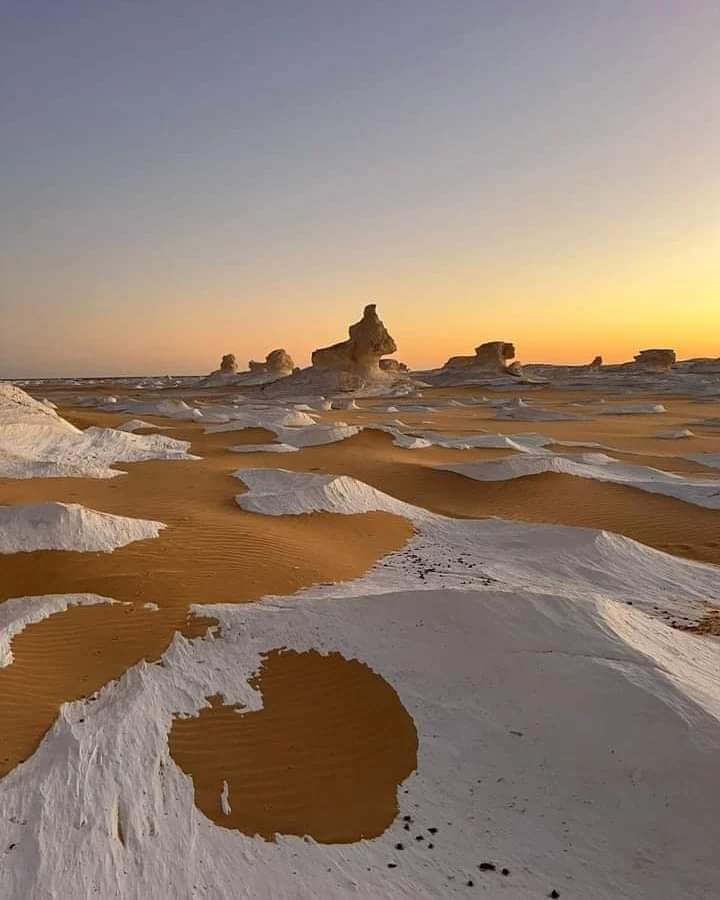
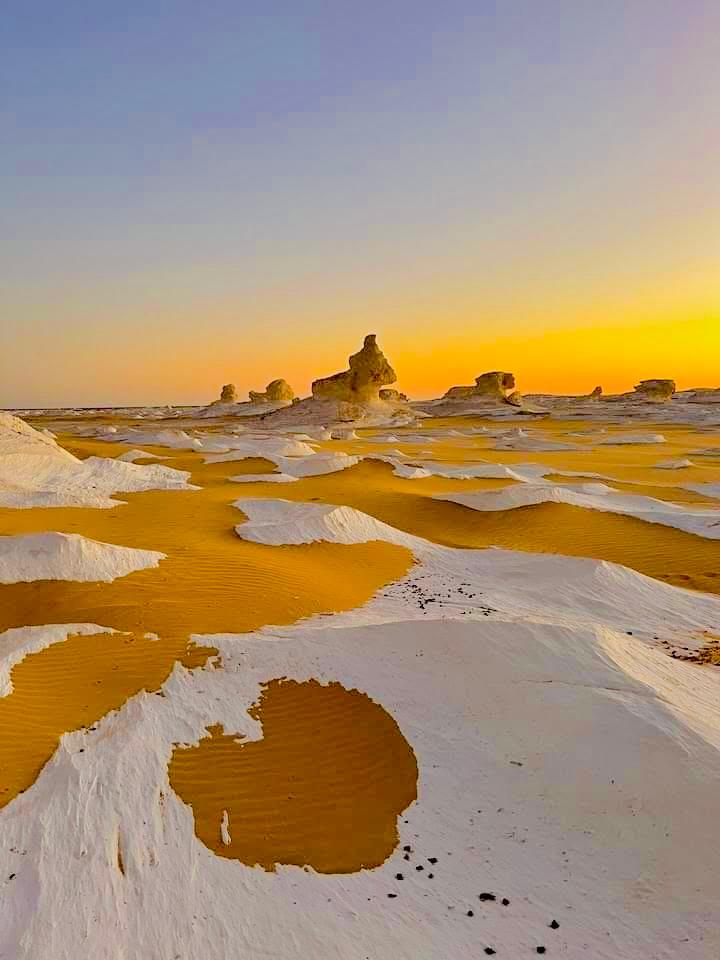
There is no pyramid, temple or museum waiting at the end of the road. Instead, the attraction is the entire landscape: enormous pale cliffs rising above golden sand, isolated rock towers appearing on the horizon, dunes flowing between geological formations and an almost complete absence of modern development.
This is Agabat Valley Egypt, one of the most dramatic landscapes on the classic Western Desert route between Bahariya Oasis and the White Desert.
It may also appear on maps and tour itineraries as Aqabat Valley, El Agabat or Al Aqabat. These spellings generally refer to the same desert region.
Egypt’s official tourism portal describes Aqabat Valley as a landscape famous for soft golden sand, beautiful dunes and signature white cliffs. It also notes that visitors may occasionally find seashells in the area, evidence of a very different ancient environment.
For most international travelers, Agabat isn’t a destination you visit by itself.
It is one of the most spectacular chapters in a larger route:
Cairo → Bahariya Oasis → Black Desert → Crystal Mountain → Agabat Valley → White Desert
That progression is part of what makes the journey special.
You begin with dark hills.
Then sparkling mineral formations.
Then enormous golden-and-white landscapes.
And eventually the surreal chalk formations of the White Desert.
If you’re planning the whole journey first, start with our White Desert Egypt complete guide.
If you’re already looking for the trip itself, explore the White Desert Safari from Cairo.
White Desert Safari: Cairo, Bahariya Oasis & Camping Adventure
Egypt Desert Dunes Explore the Journey Stop 01 White Desert Swipe photos ‹ › White Desert White Desert White Desert White Desert White Desert…
White Desert Overnight Tour from Cairo
Egypt Desert Dunes Explore the Journey Stop 01 White Desert Swipe photos ‹ › White Desert White Desert White Desert White Desert White Desert…
White Desert 3 Days Tour from Cairo
Egypt Desert Dunes Explore the Journey Stop 01 White Desert Swipe photos ‹ › White Desert White Desert White Desert White Desert White Desert…
Djara Cave and White Desert Safari
Egypt Desert Dunes Explore the Journey Stop 01 White Desert Swipe photos ‹ › White Desert White Desert White Desert White Desert White Desert…
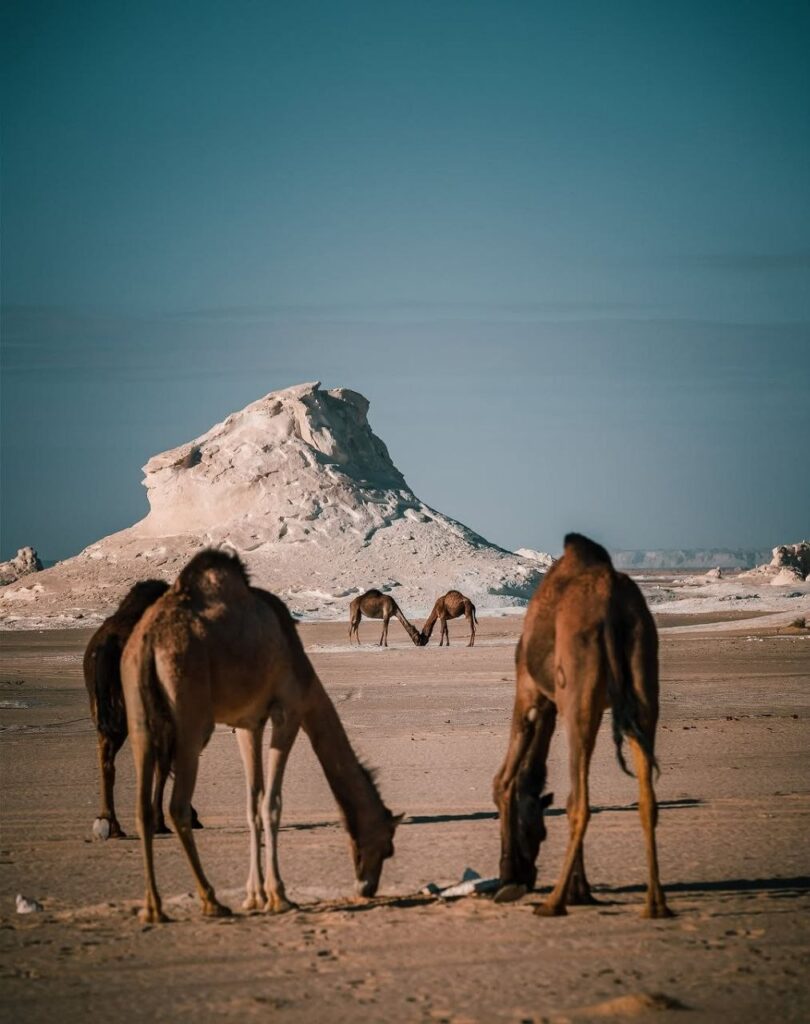
White Desert Camel Safari
Egypt Desert Dunes Explore the Journey Stop 01 White Desert Swipe photos ‹ › White Desert White Desert White Desert White Desert White Desert…
Western Desert Tour from Cairo
Egypt Desert Dunes Explore the Journey Stop 01 White Desert Swipe photos ‹ › White Desert White Desert White Desert White Desert White Desert…
Agabat Valley Egypt at a Glance
Question | Quick answer |
Where is Agabat Valley? | Egypt’s Western Desert, on the wider Bahariya–Farafra–White Desert circuit |
What is it famous for? | Golden dunes, huge pale cliffs, isolated formations and panoramic desert views |
Other spellings | Aqabat Valley, El Agabat, Al Aqabat |
Best way to visit | Organized 4×4 Western Desert safari |
Starting point for many tours | Bahariya Oasis |
Can you visit from Cairo? | Yes, normally as part of a multi-day White Desert tour |
How long should you spend there? | Around 45 minutes to several hours depending on itinerary |
Good for photography? | Excellent |
Sandboarding? | Possible on suitable dunes depending on tour and conditions |
Facilities? | Expect remote desert conditions rather than visitor facilities |
Best season | Generally cooler months for comfortable desert travel |
What Is Agabat Valley?
Agabat Valley is a remote landscape in Egypt’s Western Desert characterized by broad sandy areas surrounded by pale cliffs, rounded rock masses and heavily eroded geological formations.
Unlike the White Desert’s famous mushroom-shaped formations, Agabat often feels much larger.
The attraction isn’t necessarily one individual rock.
It’s the scale.
Standing at a high viewpoint, you may see golden sand stretching through corridors between immense pale formations while smaller rock towers appear across the horizon.
Move a few kilometers and the entire composition changes.
A cliff disappears behind a dune.
Another formation appears.
The color of the sand changes with the light.
Shadows cut across the valley.
This makes Agabat especially powerful for landscape photography.
Egypt’s national tourism portal lists the valley among the key desert excursions around Farafra and specifically highlights its soft sand, dunes and white cliffs.
It’s an excellent example of why the Western Desert should not be imagined as one endless flat sea of sand.
The landscape changes constantly.
Where Is Agabat Valley Egypt?
Agabat lies within the wider Western Desert region traveled between Bahariya Oasis, Farafra and the White Desert.
For many travelers coming from Cairo, the practical gateway is Bahariya Oasis.
Egypt’s official tourism authority places Bahariya around 370 km southwest of Cairo and describes it as the closest major Western Desert oasis to the capital.
Travelers typically reach Bahariya by paved road.
From there, the character of the trip changes.
You transfer to suitable desert vehicles and continue through landscapes such as:
Black Desert,
Crystal Mountain,
Agabat Valley,
and eventually the White Desert.
The White Desert itself lies roughly 40 km from Farafra according to Egypt’s official tourism information.
If you’d like to understand the wider geography first, use our White Desert Egypt Map guide.
Why Does Agabat Valley Look So Different?
The White Desert region is internationally known for its unusual geology.
Egypt’s Environmental Affairs Agency describes the White Desert Protected Area as a unique karst landscape containing white chalk, limestone formations, fossils, steep hills and geological structures created through long-term natural processes. The protected area was declared in 2002 and currently covers approximately 3,133.5 square kilometers according to EEAA’s protected-area information.
Agabat sits within this wider geological world.
Here, the visual contrast is particularly strong:
warm golden sand
against
pale cream and white rock.
Wind, erosion and ancient geological processes have gradually shaped the terrain into cliffs, towers, depressions and exposed sedimentary forms.
Egypt’s official tourism portal also describes Agabat as the remains of an ancient riverbed area and notes that visitors may occasionally spot seashells.
That gives the landscape an extra dimension.
The dry desert in front of you did not always look like this.
Is Agabat Valley Part of the White Desert?
This is where travel terminology gets slightly confusing.
When travelers say they’re doing a White Desert tour, they often mean the entire safari circuit rather than only the protected area filled with famous white chalk sculptures.
That circuit can include:
Bahariya Oasis,
Black Desert,
Crystal Mountain,
Agabat,
springs,
dunes,
and the White Desert itself.
So Agabat is strongly associated with White Desert trips even though its visual character is quite different from the iconic mushroom rocks most people associate with “White Desert Egypt.”
Think of it as part of the wider adventure.
Not another name for exactly the same landscape.
Agabat Valley vs White Desert
They are visually very different.
Agabat Valley | White Desert |
Huge valley-scale landscape | Fields of sculpted chalk formations |
Golden dunes | White chalk-covered terrain |
Massive cliffs and towers | Mushrooms, columns and abstract shapes |
Best appreciated through panoramas | Great for walking among individual formations |
Dramatic 4×4 scenery | Famous for camping and sunset |
Often a major route stop | Usually the main destination |
You should not really choose between them.
A good itinerary includes both.
Agabat gives the route scale.
The White Desert gives it surreal detail.
Agabat Valley vs Black Desert
The contrast is even stronger.
The Black Desert is known for dark stones scattered across hills and lighter ground.
Agabat, meanwhile, is dominated by pale cliffs and warmer golden sand.
Traveling from one to the other in the same day is one of the best demonstrations of how quickly Egypt’s Western Desert can change.
If you’d like to understand the earlier part of the route, read our Black Desert Egypt guide.
Agabat Valley vs Crystal Mountain
Crystal Mountain is comparatively small.
Agabat feels enormous.
At Crystal Mountain Egypt, you’re often looking closely at crystals, cavities and geological details.
At Agabat, you’re looking outward.
The attraction is distance.
Scale.
Layers.
Huge formations separated by open desert.
That’s why the two stops complement each other so well.
What Can You Do in Agabat Valley?
Agabat isn’t an amusement park filled with scheduled activities.
The landscape itself is the experience.
But there are several ways to enjoy it.
- Explore the Valley by 4×4
For many visitors, entering Agabat by off-road vehicle is one of the highlights.
Tracks cross golden sandy areas between formations, creating constantly changing viewpoints.
Some sections can feel wide and open.
Others become more enclosed between larger rock structures.
A capable vehicle matters here, but so does the person driving it.
Experienced desert drivers understand:
sand conditions,
local tracks,
terrain,
vehicle limitations,
and the best viewpoints.
That’s more important than simply having a vehicle labeled “4×4.”
- Stop at Panoramic Viewpoints
Don’t experience Agabat entirely through a car window.
One good high viewpoint can completely change your understanding of the valley.
From above, you begin seeing how the:
dunes,
cliffs,
rock towers,
and open sandy areas
connect to each other.
The scale is difficult to appreciate from ground level.
If your itinerary allows it, spend a little time in silence rather than treating every stop as a five-minute Instagram session.
- Walk Through the Desert
A short walk can be more memorable than another 20 minutes of driving.
The desert feels different on foot.
You hear the wind more clearly.
You notice tracks in the sand.
Rock textures become visible.
And without the vehicle beside you, the landscape suddenly feels much larger.
However, don’t walk away from your guide or vehicle without coordination.
Agabat is remote terrain, not a marked city hiking path.
- Try Sandboarding
Egypt’s official tourism site specifically mentions dune jumping in Agabat Valley’s soft golden sand as one of the hidden-gem experiences around Farafra.
Some organized safaris may also include sandboarding depending on the route, equipment and suitable dunes.
You do not need advanced experience.
Usually, you climb a dune and slide down using a simple board.
Getting up the dune again tends to require more energy than coming down.
If sandboarding is important to you, confirm that equipment is included before booking rather than assuming every White Desert tour provides it.
- Photograph the Landscape
Agabat may be one of the best landscape-photography stops on the entire Western Desert circuit.
Why?
Because of layers.
You can build images using:
foreground dunes,
midground rock towers,
background cliffs,
and open sky.
This creates much more visual depth than a flat desert scene.
For more detailed equipment and shooting advice, see our White Desert Photography Tips guide.
Best Time to Photograph Agabat Valley
The middle of the day can still be beautiful.
But lower-angle light usually creates stronger landscape photography.
Why?
Shadows.
At midday, sunlight falls more directly on the terrain and some formations can appear flatter.
During earlier or later light, shadows reveal:
ridge lines,
erosion,
cliff faces,
dune textures,
and distance between formations.
Golden-hour light also warms the sand dramatically.
Unfortunately, tour timing matters.
Many itineraries need to reach the White Desert before sunset, which means Agabat may be visited earlier in the afternoon.
If landscape photography is a major priority, consider a longer itinerary rather than the fastest possible tour.
Sunrise or Sunset in Agabat Valley?
Both could be beautiful.
But most standard White Desert trips are structured around sunset in the White Desert itself.
That means Agabat is often visited before the final sunset stop.
This isn’t necessarily a problem.
Afternoon light across the dunes can be spectacular.
But if you specifically want sunrise or sunset at Agabat, discuss the route with your operator before departure.
Don’t assume every itinerary camps beside the valley.
How Long Should You Spend in Agabat Valley?
There is no fixed answer.
A rushed tour may stop for around 20–30 minutes.
A better-paced itinerary may spend an hour or more exploring different areas.
Longer expeditions can give you several hours within the wider landscape.
My practical recommendation:
Allow at least 45–60 minutes if Agabat is important to you.
That gives you enough time to:
walk,
photograph,
see multiple angles,
and enjoy the environment
rather than simply stopping beside the vehicle for a photo.
This is one reason a longer White Desert itinerary can feel dramatically better than a very compressed one.
We’ve compared those formats in our 2-Day vs 3-Day White Desert Tour guide.
Can You Visit Agabat Valley from Cairo?
Yes.
But not as the kind of simple day trip where you leave Cairo after breakfast and return after dinner.
Cairo is hundreds of kilometers from the White Desert circuit.
Most international visitors first travel toward Bahariya Oasis.
Egypt’s official tourism authority estimates the trip to Bahariya from Cairo at roughly five hours by road depending on transport and conditions.
From Bahariya, desert safari logistics continue.
This is why a proper White Desert experience is generally planned as at least an overnight journey.
If you’re researching the journey itself, read our Cairo to White Desert Egypt guide.
A Typical Cairo to Agabat Valley Route
A classic itinerary might follow:
Cairo
↓
Bahariya Oasis
Road transfer, food, supplies and safari arrangements.
↓
Black Desert
Explore dark hills and contrasting geological terrain.
↓
Crystal Mountain
See exposed crystals and the famous small natural opening.
↓
Agabat Valley
Explore enormous pale formations, dunes and viewpoints.
↓
White Desert
Continue into the chalk landscape for sunset, camping and sunrise.
This isn’t simply a transport route.
Each section intentionally looks different from the previous one.
That’s what makes the journey feel like an expedition rather than a long drive to one attraction.
Should You Stay Overnight?
Yes, if you’re coming from Cairo.
An overnight White Desert safari makes far more sense than trying to experience this region as a rushed day excursion.
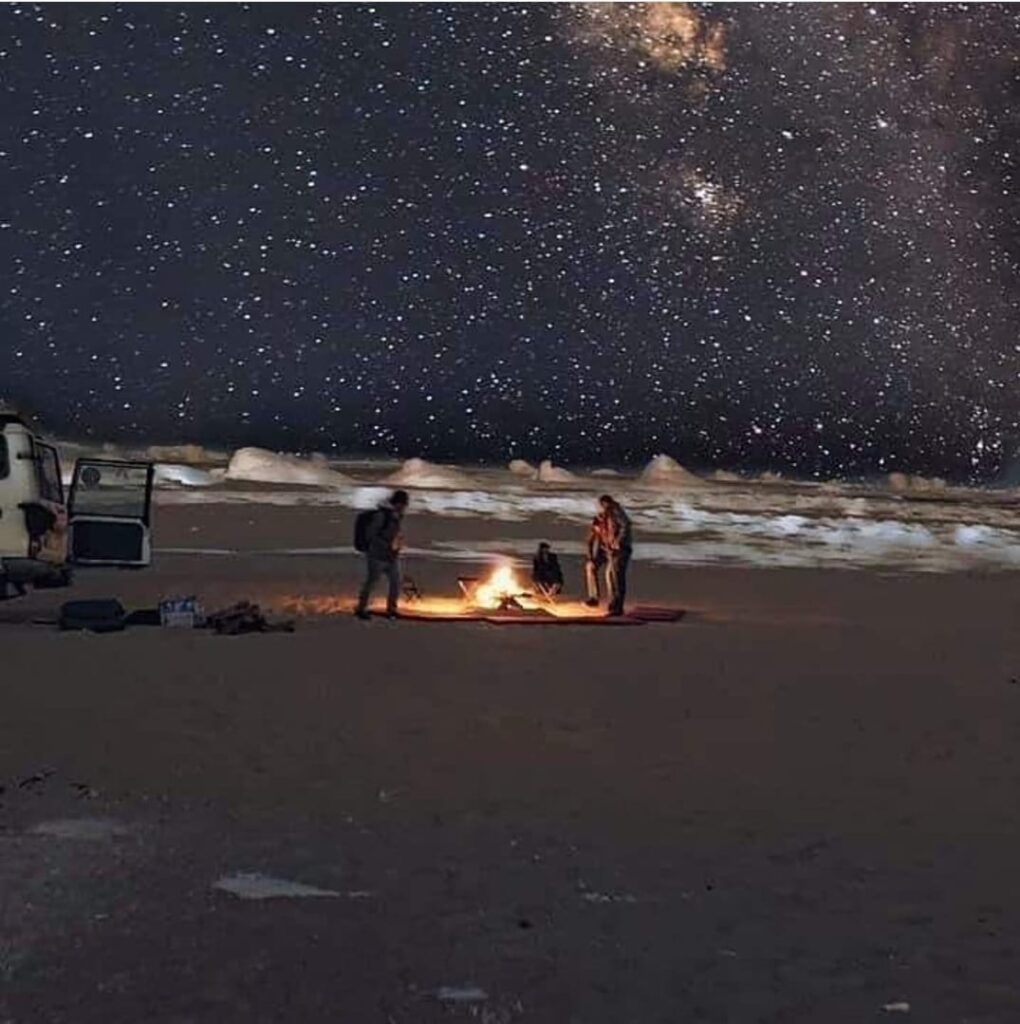
Camping adds something that no daytime stop can provide:
silence after dark.
After sunset, temperatures fall and the atmosphere changes completely.
Dinner is prepared.
Tea appears.
Artificial light disappears.
The desert sky becomes dramatically more visible.
Then in the morning, you wake inside the landscape rather than arriving from a hotel.
For detailed planning, read our White Desert Camping Guide.
If you’re ready to book the classic route, see the White Desert Overnight Tour from Cairo.
2 Days or 3 Days for Agabat Valley?
For many first-time travelers:
2 days / 1 night
is enough to experience the main route.
You can typically combine:
Bahariya,
Black Desert,
Crystal Mountain,
Agabat,
White Desert,
camping,
sunset,
and sunrise.
But the compromise is pace.
3 days / 2 nights
gives you more time.
That matters if you’re interested in:
photography,
walking,
sandboarding,
additional desert areas,
longer stops,
or simply enjoying the landscape without constantly checking the time.
If this sounds more appealing, explore our White Desert 3 Days Tour from Cairo.
Best Time to Visit Agabat Valley Egypt
For most travelers, cooler months are more comfortable for Western Desert exploration.
The reason is simple.
There is very little shade.
You may spend significant periods:
walking,
standing in exposed sunlight,
driving across the desert,
and camping outdoors.
Cooler daytime temperatures make all of that easier.
Evenings can become surprisingly cool, especially in winter, so desert travel requires thinking about both daytime sun and nighttime cold.
For a more detailed seasonal breakdown, see our Best Time to Visit White Desert Egypt.
What Should You Wear?
You don’t need specialist expedition clothing for a standard Agabat stop.
But you should dress for a desert environment.
Useful items include:
- lightweight, breathable clothing;
- comfortable closed walking shoes;
- sunglasses;
- sun hat;
- sunscreen;
- scarf or buff;
- warmer evening layer;
- jacket during colder periods.
Shoes matter more than people expect.
You may be walking across:
sand,
rock,
uneven ground,
and slopes.
Flip-flops are rarely the best choice for serious desert exploration.
Our White Desert packing guide covers the full trip checklist.
Is Agabat Valley Safe?
The physical sightseeing itself is generally not technically difficult for ordinary visitors.
The important issue is remoteness.
You’re traveling through a desert area with:
limited phone reception,
limited medical infrastructure,
unmarked off-road routes,
and changing permit or access requirements.
Current UK travel guidance says tourists entering Bahariya, Farafra, the White Desert and Black Desert must arrange permits in advance and use an official guide. It also notes limited phone reception and medical facilities.
Egypt’s official tourism portal similarly advises travelers to check permits and regulations with an authorized guide or travel agency before heading into desert areas.
This is why current information matters more than an old travel blog.
For broader planning, see our White Desert Egypt Safety Guide.
Do You Need a Guide for Agabat Valley?
For a normal international tourist itinerary:
use an experienced licensed desert operator and guide.
This isn’t just about convenience.
An experienced team handles:
route knowledge,
vehicles,
permits,
food,
drinking water,
camping equipment,
navigation,
timing,
and emergency planning.
Egypt’s official tourism portal specifically recommends experienced licensed guides familiar with the terrain for desert excursions from Bahariya.
A Google Maps pin isn’t a substitute for desert knowledge.
Are There Toilets or Facilities in Agabat Valley?
Travel with the expectation that Agabat is a remote desert landscape, not a developed visitor complex.
Don’t expect:
cafes,
souvenir shops,
public bathrooms,
ATMs,
charging stations,
or reliable mobile signal
at every stop.
Your tour team should plan necessary supplies.
Bring what you need before leaving the oasis.
This includes:
water,
medication,
power banks,
sun protection,
and personal hygiene items.
Remote conditions are part of the attraction — but they require preparation.
Can Families Visit Agabat Valley?
Yes, many families can enjoy a White Desert safari.
The more important questions are:
How old are the children?
Are they comfortable with several hours of driving?
Can they handle basic camping conditions?
Do they enjoy outdoor travel?
A private safari can often work better for families because the pace can be adjusted.
Longer itineraries also prevent the day from becoming a nonstop race between stops.
Is Agabat Good for Solo Travelers?
Absolutely.
But solo travelers should think about trip structure.
A shared tour may lower cost.
A private tour gives more flexibility.
If photography is your priority, private travel can be especially valuable because you can sometimes spend longer at specific viewpoints rather than following a fixed group schedule.
We’ve covered traveler types more broadly in our White Desert safari for couples, families and solo travelers guide.
Responsible Travel in Agabat Valley
Remote doesn’t mean indestructible.
The wider White Desert region is environmentally significant.
Egypt’s Environmental Affairs Agency describes the White Desert as a protected landscape containing distinctive geological structures, fossils, wildlife and rare natural features.
A management plan for the protected area uses different zones with different levels of access and protection; some strict nature zones prohibit public vehicle access and camping entirely.
So:
don’t drive wherever you want,
don’t remove fossils,
don’t collect stones,
don’t carve names into formations,
don’t leave trash,
and don’t assume every beautiful place is an authorized campsite.
Follow local guides and protected-area regulations.
The desert may look empty.
It isn’t without value.
Can You Find Fossils or Seashells in Agabat?
Official Egyptian tourism information specifically notes that occasional seashells may be seen in Aqabat Valley and describes the area as the site of an ancient riverbed.
If you notice fossils or shells:
photograph them,
look at them,
leave them where they are.
Don’t treat geological material as free souvenirs.
Part of responsible travel is allowing the next visitor to see the same natural evidence you did.
What Makes Agabat Valley Worth Visiting?
There’s a temptation in travel planning to rank every stop as:
“must-see”
or
“skip.”
Agabat doesn’t need that kind of hype.
Its value is very specific.
It gives the White Desert journey scale.
Crystal Mountain is detailed.
The Black Desert is visually dark and rugged.
The White Desert is surreal.
Agabat is vast.
It creates the feeling that you have genuinely entered the Western Desert.
The best moment may not be a famous formation at all.
It might simply be standing above the valley with:
no buildings,
no city noise,
no crowds,
and desert stretching beyond the horizon.
Is Agabat Valley Worth a Separate Trip?
From Cairo?
Probably not.
I wouldn’t recommend traveling all the way from Cairo purely to spend an hour in Agabat and then return.
But as part of a White Desert safari?
Absolutely.
It is one of the landscapes that makes the route feel complete.
That’s why choosing your itinerary based only on the White Desert’s mushroom formations misses half the experience.
The journey matters.
Agabat Valley Photography Tips
If you’re bringing a camera, keep these principles in mind.
Use People for Scale
The rock formations can appear smaller in photos than they feel in real life.
A person or vehicle can immediately communicate size.
Look for Layers
Try compositions with:
sand in the foreground,
formation in the middle,
distant cliffs behind.
Protect Highlights
Pale rock under bright sunlight can become overexposed.
Check your histogram or exposure.
Shoot Textures
Not every photo needs to be a giant panorama.
Sand ripples, rock surfaces and shadows can produce excellent detail images.
Protect Your Equipment
Sand gets everywhere.
Avoid unnecessary lens changes during windy conditions.
Stay for Changing Light
A location that looks flat at one moment can become dramatic 20 minutes later when shadows move.
What Else Should You Visit Near Agabat Valley?
Agabat makes the most sense as part of a network of Western Desert attractions.
Crystal Mountain
A mineral-rich geological formation famous for exposed crystals and its small arch.
Read the Crystal Mountain Egypt complete guide.
Black Desert
Dark-capped hills and stones create one of the route’s strongest visual contrasts.
Read the Black Desert Egypt guide.
White Desert
The famous protected chalk landscape and main destination for many trips.
Read the White Desert Egypt guide.
Bahariya Oasis
The practical gateway for many Cairo-based safaris.
Read the Bahariya Oasis Egypt guide.
How Much Does an Agabat Valley Tour Cost?
Agabat usually isn’t sold as a separate attraction with one universal price.
It’s generally included inside a wider White Desert safari.
Cost therefore depends on factors such as:
trip length,
private vs shared tour,
number of guests,
Cairo transfers,
vehicle arrangement,
camping equipment,
meals,
permits,
entrance fees,
and accommodation.
Instead of comparing only headline prices, compare what is actually included.
A cheap tour that rushes Agabat in ten minutes may not represent better value than a slightly more expensive itinerary giving you real time in the desert.
For a broader breakdown, use our White Desert Egypt Cost Guide.
Plan Your Agabat Valley & White Desert Safari
Agabat Valley isn’t the final destination.
That’s part of its charm.
You reach it while moving deeper into Egypt’s Western Desert.
Behind you:
Bahariya,
the Black Desert,
Crystal Mountain.
Ahead:
the White Desert,
sunset,
camping,
stars,
and sunrise.
Each landscape transforms into the next.
That’s why the best way to understand Agabat isn’t through one photograph.
It’s to experience its place within the route.
For the classic adventure, explore the White Desert Safari from Cairo.
If camping overnight is your priority, see the White Desert Overnight Tour from Cairo.
For a slower trip with more time in the landscape, consider the White Desert 3 Days Tour from Cairo.
And if you’re still comparing options, browse all Egypt Desert Dunes tours.
White Desert Safari: Cairo, Bahariya Oasis & Camping Adventure
Egypt Desert Dunes Explore the Journey Stop 01 White Desert Swipe photos ‹ › White Desert White Desert White Desert White Desert White Desert…
White Desert Overnight Tour from Cairo
Egypt Desert Dunes Explore the Journey Stop 01 White Desert Swipe photos ‹ › White Desert White Desert White Desert White Desert White Desert…
White Desert 3 Days Tour from Cairo
Egypt Desert Dunes Explore the Journey Stop 01 White Desert Swipe photos ‹ › White Desert White Desert White Desert White Desert White Desert…
Djara Cave and White Desert Safari
Egypt Desert Dunes Explore the Journey Stop 01 White Desert Swipe photos ‹ › White Desert White Desert White Desert White Desert White Desert…
White Desert Camel Safari
Egypt Desert Dunes Explore the Journey Stop 01 White Desert Swipe photos ‹ › White Desert White Desert White Desert White Desert White Desert…
Western Desert Tour from Cairo
Egypt Desert Dunes Explore the Journey Stop 01 White Desert Swipe photos ‹ › White Desert White Desert White Desert White Desert White Desert…
Book a Tour or Create Your Own Egypt Experience
Choose one of our ready-made tours or customize your own private journey. Select your destinations, duration and travel style, then send your request directly to Egypt Desert Dunes on WhatsApp.
Book Your Desert Tour
Select your preferred itinerary and send us your travel details. Our team will reply on WhatsApp with availability and the final quote.
Create Your Own Private Egypt Tour
Combine Cairo, Giza, Fayoum, the Western Desert and Siwa in one custom itinerary. Choose the destinations and experiences you want and our team will recommend the best route based on your available days.
Book Egypt Desert Dunes Tours on Viator
Discover our private White Desert camping adventures and Siwa Oasis experience. Choose your favorite itinerary and complete your reservation securely through Viator.
4-Day Private Camping Tour in the White Desert from Cairo
Go deeper into Egypt's Western Desert with a private four-day camping adventure including spectacular desert landscapes, Black Desert, White Desert, open-air meals and three nights beneath the stars.
2-Day, 1-Night Camping Tour in White Desert from Cairo
Our most compact White Desert adventure for travelers who want to experience the desert from Cairo, explore its unique landscapes and spend an unforgettable night camping beneath the stars.
3-Day Private Camping Tour of White Desert from Cairo
Spend three days exploring the Western Desert, including the Black Desert, Crystal Mountain, Aqabat area and White Desert, with two nights of private desert camping.
Siwa Oasis Trip with Cairo Pick Up
Travel from Cairo to legendary Siwa Oasis on a private four-day journey exploring Siwan culture, desert landscapes, Lake Siwa, traditional sites and some of the oasis's most distinctive attractions.
Explore Egypt's Desert with Egypt Desert Dunes
From a one-night White Desert camping adventure to extended Western Desert and Siwa Oasis experiences, choose the itinerary that matches your travel style and complete your booking through Viator.
FAQ — Agabat Valley Egypt
What is Agabat Valley Egypt? +
Agabat Valley is a dramatic Western Desert landscape known for golden sand dunes, large pale cliffs, isolated rock formations and panoramic desert scenery. It is commonly visited as part of White Desert safari routes between Bahariya and the Farafra region.
Where is Agabat Valley located? +
Agabat Valley lies in Egypt's Western Desert within the broader desert circuit connecting Bahariya Oasis, Crystal Mountain, Farafra and the White Desert.
Is Agabat Valley part of the White Desert? +
Agabat is commonly included on White Desert safari itineraries, although its golden dunes and massive cliffs look different from the famous chalk formations associated with the main White Desert landscape.
How do you get to Agabat Valley from Cairo? +
Most travelers drive from Cairo to Bahariya Oasis and then continue with an organized desert safari using suitable off-road vehicles and experienced local guides.
Do you need a 4x4 for Agabat Valley? +
A suitable 4x4 is normally used for the off-road desert sections around Agabat. Travelers should arrange desert excursions with experienced guides and operators familiar with current routes and regulations.
How long should you spend in Agabat Valley? +
Around 45 to 60 minutes provides enough time for a meaningful first stop, although travelers interested in photography, walking or slower desert exploration may want considerably longer.
Can you camp in Agabat Valley? +
Camping locations depend on current protected-area regulations, permits and itinerary design. Many White Desert safaris camp elsewhere along the wider route rather than at the exact Agabat viewpoint.
Can you go sandboarding in Agabat Valley? +
Yes, suitable dunes around the Agabat area can be used for dune activities and sandboarding depending on local conditions and the equipment provided by your safari operator.
What is the best time to visit Agabat Valley? +
The cooler months are generally the most comfortable period for Western Desert travel because visitors spend significant time outdoors in exposed desert conditions.
Is Agabat Valley safe to visit? +
Agabat is remote desert terrain, so visitors should travel with appropriate guides, vehicles and current permits. Travelers should also check current government travel advice and local regulations before departure.
Is Agabat Valley worth visiting? +
Yes. Agabat offers one of the most dramatic panoramic landscapes on the classic White Desert route and provides a strong visual contrast with the Black Desert, Crystal Mountain and White Desert.
What should I bring to Agabat Valley? +
Bring sun protection, comfortable closed shoes, water, sunglasses, a hat, suitable seasonal layers and personal medication. It is also useful to protect cameras, phones and other electronics from sand and dust.
